Medewerker van de maand (februari 2023): Alexander Vandewalle

Onze medewerker van de maand februari, Alexander Vandewalle, pendelt normaalgezien tussen Antwerpen en Gent, maar maakte vorige maand een wat langere reis, naar Nieuw-Zeeland dan nog wel! Evelien Bracke sprak met hem over zijn congrespaper, over video games en, jawel, Middle Earth.
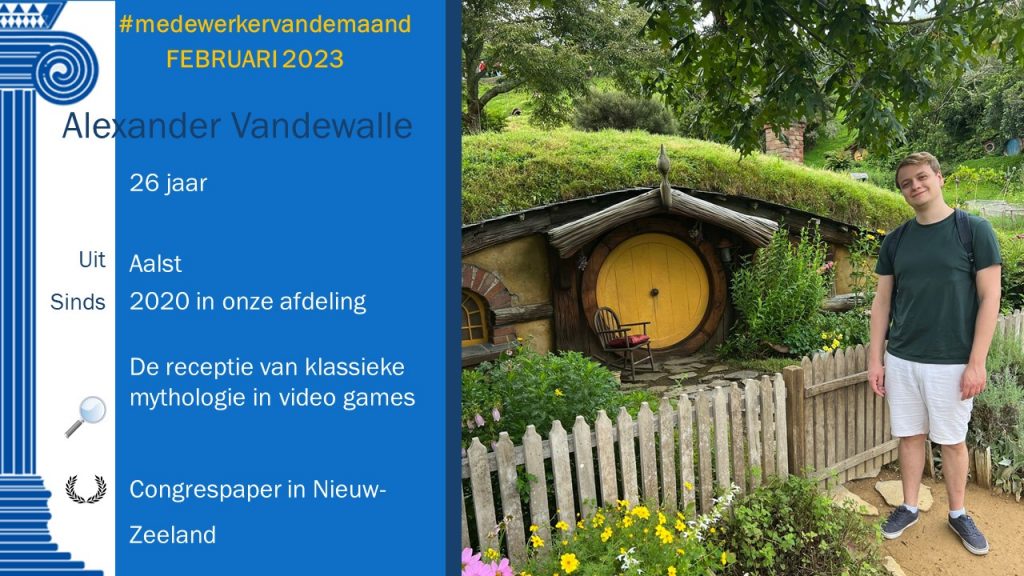
Dag Alexander, leuk om even met jou te spreken. Je naam is veel mensen wel bekend als onderzoeker van de rol van de oudheid in videogames. Wat een interessant thema! Kan je uitleggen wat jouw onderzoek inhoudt? (En houdt het dan ook in dat je heel veel videogames moet uittesten?)

Bedankt! Specifiek kijk ik in mijn onderzoek naar de karakterisering van Grieks-Romeinse goden en helden in video games. In het eerste deel van mijn doctoraat stelde ik een framework op van karakteriseringstechnieken of -indicaties in games, waarvoor ik mij baseerde op bestaand onderzoek uit de letterkunde, narratologie, filmstudies, en game studies. Het resulterende kader pas ik momenteel toe op een corpus van mythologisch geïnspireerde video games, waarbij ik kijk naar gelijkaardige tendensen tussen verschillende games, of verschillen qua representatie tussen game-genres of productiecontexten. Gamen is dus inderdaad een belangrijk deel van mijn werkdag, hoewel het natuurlijk ook niet enkel om spelen draait!

Ik ben al eens op je database gaan snuisteren. Wat een uitgebreide lijst – en zoveel games waar ik nog nooit van gehoord heb! Hoe ben je hieraan begonnen, en hoe houd je zoiets bij?

Het idee voor de Paizomen-database ontstond origineel tijdens mijn FWO-applicatie: ook al is de academische interesse naar klassieke receptie in games de laatste jaren enorm toegenomen, toch bestond er nergens een grote lijst van ‘alle’ games die zich in de klassieke oudheid afspelen. (En om eerlijk te zijn: een deel van de inspiratie kwam ook uit het werk van de DBBE!) Bij het opstellen van de database ben ik op zoek gegaan naar alle mogelijke informatie die ik kon vinden, zoals academische publicaties, online encyclopedia’s, winkelplatformen, trailers, fora, game-gidsen (waarin spelers bijvoorbeeld aan andere spelers uitleggen hoe je het best aan een bepaalde game begint) en meer, om op die manier een overzicht te bieden van de enorme hoeveelheid games over de oudheid. Momenteel bevat de database informatie over iets meer dan 300 games, maar ik loop intussen alweer achter, en er zijn zeker nog honderden of zelfs duizenden games te vinden die zich door de oudheid laten inspireren!

Je onderzoek doe je zowel aan de Universiteit Antwerpen als aan de UGent. Hoe werkt dat praktisch gezien? Komt er veel pendelwerk bij kijken?

Ik onderneem inderdaad een dubbeldoctoraat: UAntwerpen is mijn hoofdinstelling, waar ik werk bij Communicatiewetenschappen, en UGent mijn partnerinstelling, waar ik bij de Afdeling Grieks aansluit. Ik heb aan beide universiteiten ook gestudeerd, dus is het mooi om deze zo te kunnen combineren. Dat betekent inderdaad geregeld pendelen, hoewel ik voor het grootste deel van thuis uit werk: voor mijn onderzoek heb ik uiteraard vaak mijn game-consoles nodig, en het is moeilijk om deze constant met de trein te verhuizen. De combinatie van de twee universiteiten heeft ook al voor mooie samenwerkingen gezorgd: aan UAntwerpen werk ik geregeld samen met andere game-onderzoekers die vanuit hun achtergrond in de sociale wetenschappen expertise hebben in publieksonderzoek (bv. meer kwantitatieve en statistisch gerichte studies, enquêtes, interviews), waar ik zelf niet in getraind ben. Dit stond mij toe om onderzoek te verrichten naar verschillende ervaringen die spelers meemaken in oudheidgames – iets waar ik anders maar moeilijk aan begonnen zou zijn, maar wat wel ongelooflijk interessant is.

Je twitter-account vertelt ons dat je nog maar net terug bent uit Nieuw-Zeeland. Waarover heb je gesproken op het congres waar je daar aan deelnam? En blijkbaar ben je ook naar Hobbiton geweest?

Klopt! Ik ben naar Nieuw-Zeeland afgereisd om daar een presentatie te geven op de jaarlijkse samenkomst van de Australasian Society for Classical Studies (ASCS), waar het thema dit jaar ‘Games and the Ancient World’ was: een hele dag presentaties over de oudheid en/in games, wat nog steeds redelijk zeldzaam is voor Classics-conferenties. Mijn presentatie betrof zogenaamde ‘haptic feedback’ in mythologische video games, of spontane vibraties of trillingen die spelers via hun game-controller ontvangen wanneer ze aan het spelen zijn. Ik heb een aantal games besproken en beargumenteerd dat dergelijke tactiele elementen bijdragen tot een specifiek soort ervaring van mythologie (of althans een bepaalde conceptualisering ervan door de huidige entertainmentindustrie) waarbij spelers in de rol van een god ondergedompeld worden, en waar de focus vaak op spektakel en goddelijke krachten ligt.

En ja, het leek een beetje jammer om helemaal naar Nieuw-Zeeland te vliegen en er slechts de vier dagen van de conferentie rond te lopen, dus hebben we er een grotere trip van gemaakt en inderdaad ook Hobbiton bezocht! Als Lord of the Rings-fan kon dit absoluut niet ontbreken. Het was een heel speciale ervaring om die prachtige set rond te wandelen, en ik was enorm onder de indruk van het detail waarmee Peter Jackson Middle-Earth daar tot leven heeft gebracht. Nieuw-Zeeland is trouwens ook gewoon een prachtig land met adembenemende natuur en gezellige steden – een grote aanrader! (Aangezien het daar in januari en februari nog volop zomer is, was het daar ook nog eens een goede 20 à 25° warmer dan hier!)

En misschien een beetje een cliché vraag om mee te eindigen, maar wat is jouw favoriete videogame waarin de oudheid voorkomt? En – misschien iets controversiëler – je minst favoriete? Wat zou je ons aanraden?

Een lastige vraag! Zo’n dingen evolueren altijd een beetje. Assassin’s Creed Odyssey hoort de facto thuis in mijn favorieten, aangezien het de game was die mij als eerste deed nadenken over games en klassieke receptie. Ik vind het nog steeds een mijlpaal in de geschiedenis van oudheidgames, die het klassieke Griekenland van Perikles op een naar mijn mening nog ongeëvenaarde manier heeft weergegeven. De game is zeker niet perfect (bij tijden heb ik er eerder een haat-liefde-relatie mee), maar ik kan er zelfs na 200 uur speeltijd en drie playthroughs nog steeds van blijven genieten. Andere favorieten zijn Immortals Fenyx Rising, die de Griekse mythologie op een vooral komische manier weergeeft; de God of War-reeks, die er in de laatste jaren in geslaagd is om één van de gewelddadigste game-reeksen aller tijden om te vormen naar een diep emotioneel vader-zoon-verhaal; en Hades, waarin spelers in de rol kruipen van het obscure mythologische personage Zagreus en keer op keer proberen de Onderwereld te ontsnappen op zoek naar Zagreus’ moeder, Persefone. In december werd een vervolg op Hades aangekondigd, Hades II, dat zal draaien rond het misschien nog obscuurdere personage Melinoë (bekend uit slechts één Orfische hymne) en nog een aantal nieuwe personages zal introduceren (onder wie bijvoorbeeld Hekate). Naar deze ben ik ongelooflijk benieuwd!

Over het algemeen ben ik iets minder fan van strategiegames als Civilization – niet omdat die games niet leuk kunnen zijn, maar omdat ik zelf als speler vooral ben opgegroeid met de meer narratieve, avontuurlijke games. De groep games waar ik persoonlijk het minst graag mee bezig ben zijn mobile games, of games die gemaakt zijn voor smartphones. Hier bekruipt mij altijd een dubbel gevoel: enerzijds worden ze door miljoenen spelers gespeeld (en zijn ze daarom belangrijke, maar nog steeds onderbelichte, studieobjecten), maar anderzijds vind ik ze vaak ietwat vervelende speelervaringen. Meer dan bij computer- of console-games maken mobile games het je vaak expres moeilijk of lastig, en is het de bedoeling dat je tegen betaling (zogenaamde ‘microtransactions’) de speelervaring bevordert (bijvoorbeeld om upgrades te krijgen, of om de constructie van bepaalde gebouwen sneller te doen vooruitgaan). Ook zijn er gewoon zodanig veel van, dat ik nooit goed weet waar exact te beginnen…

Bedankt voor de tips! We weten nu wat te doen deze zomer! Nog veel succes met je onderzoek.
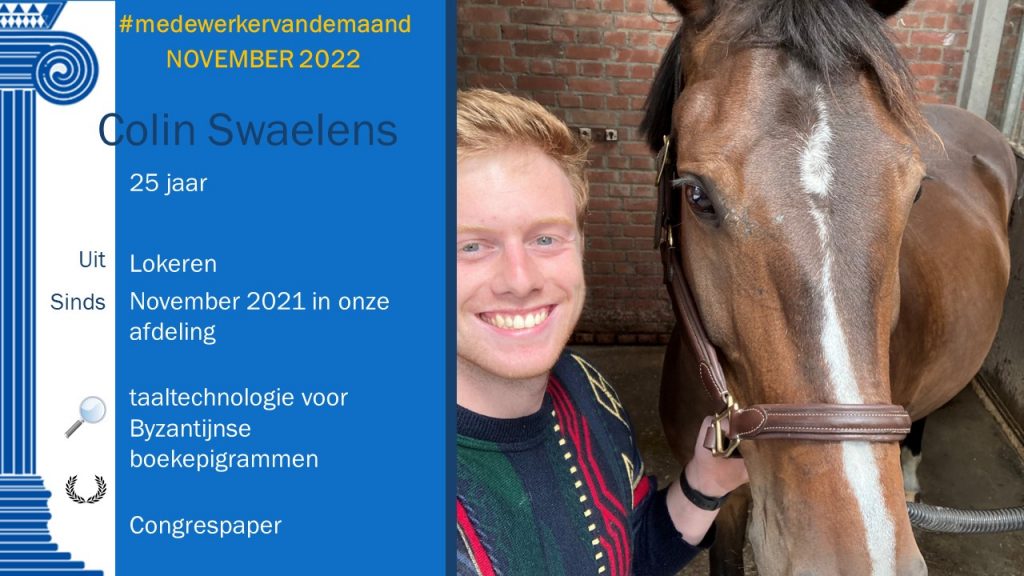
Medewerker van de maand (november 2022): Colin Swaelens

Interdisciplinair onderzoek rond taaltechnologie, daarvoor moeten we bij Colin Swaelens zijn. Een jaar geleden startte hij in onze afdeling als doctoraatsstudent. Alexandra Vereeck praat met hem over taalmodellen, congressen, en verhuizen. 

Dag Colin, wat leuk even met je te spreken! Een jaar geleden startte je als doctoraatsstudent aan de UGent. Kan je uitleggen waarover je onderzoek gaat?

Het onderzoek maakt deel uit van een groter project rond de Database of Byzantine Book Epigrams (DBBE). Samen met mijn promotoren Els Lefever en Ilse De Vos ben ik op dit moment bezig met het trainen van een taalmodel, dat gebruikt zal worden om de boekepigrammen automatisch van een taalkundige analyse te voorzien. Vervolgens zullen we onderzoeken hoe we kunnen berekenen in welke mate halfverzen, verzen en epigrammen aan elkaar gelijk zijn, om die dan op een dynamische manier aan elkaar te linken.

Lijkt me een interessante invalshoek op het DBBE-project! Vertel eens, hoe heb je je eerste jaar ervaren?

In het eerste jaar heb ik alle cursussen gevolgd om de Doctoral Schools af te ronden en een FWO-aanvraag geschreven. Hoewel die niet aanvaard werd, bleek het een goede leidraad te zijn om me op een gestructureerde manier door het onderzoek te leiden. Samen met enkele collega’s ben ik al enkele keren op conferentie kunnen gaan, wat telkens een leuke ervaring was. Dat het onderzoek zich bevindt op het snijvlak van taaltechnologie en Grieks, is uitdagend omdat het een erg uiteenlopend publiek is. Die uitdaging is fijn, zeker als je dan bijvoorbeeld op een conferentie ziet dat de community je werk apprecieert.

We zijn op dit moment verschillende taalmodellen aan het trainen om te kijken welk het beste werkt om de taalkundige analyse te doen. Die experimenten en resultaten zijn we aan het bijhouden om een eerste journal-artikel te schrijven.

Dat is inderdaad het boeiende van onderzoek dat bij verschillende disciplines aanhaakt. Hiervoor studeerde je net zoals ik in Leuven. Was de stad Gent nieuw voor jou? Zijn er jou zaken opgevallen bij deze verandering van universiteit?

Op een schoolbezoek na was Gent inderdaad nieuw voor mij. De stad is nog steeds een doolhof voor mij, wat voor enkele minuten vertraging zorgt als ik met de fiets verdwaald raak in het centrum. De verandering waar ik het meeste moeite mee had, was de overschakeling van Toledo naar de verschillende digitale platformen van de UGent, ietwat lachwekkend voor iemand van de afdeling taaltechnologie. Ik begin ondertussen wel de weg te vinden tussen Oasis, Ufora en Apollo 🙂

Klinkt zeer herkenbaar, Colin! Rond de tijd dat jij begon, in november 2021, werden trouwens de coronamaatregelen terug aangescherpt. Dit najaar zijn er voorlopig nauwelijks beperkende maatregelen meer. Werk(te) je vooral vanop afstand of on campus? Over campus gesproken: vinden we je meestal terug op campus Mercator of campus Boekentoren?

Ik ben mijn eerste week in quarantaine begonnen; de dag voor mijn start aan de UGent testte ik positief op corona. Nadien heb ik halftijds van thuis, halftijds op kantoor gewerkt. Nu werk ik wat vaker op kantoor, maar ben toch nog steeds een dag thuis aan het werk. De andere dagen vind je me voornamelijk terug bij LT3 op campus Mercator.

Dat het onderzoek zich bevindt op het snijvlak van taaltechnologie en Grieks, is uitdagend omdat het een erg uiteenlopend publiek is. Die uitdaging is fijn, zeker als je dan bijvoorbeeld op een conferentie ziet dat de community je werk apprecieert.

Aha, dat verklaart waarom ik je nog niet vaak op de Blandijn heb gezien. Verschillende leden van de Afdeling Grieks zijn wel betrokken bij je project, toch? Met wie werk je zoal samen?

Voor het onderzoek werk ik voornamelijk samen met Kristoffel Demoen, Floris Bernard, Klaas Bentein en het DBBE-team. Vorig academiejaar was ik ook betrokken bij de organisatie van het Festival Européen Latin Grec met Evelien Bracke.

En waar ben je op dit moment allemaal mee bezig? Ik hoorde dat je het erg druk hebt.

Klopt, afgelopen week had ik samen met Maxime Deforche (die ook betrokken is bij de GOA rond DBBE) en Ilse De Vos een conferentie in Wenen over mogelijke digitale alternatieven voor een kritische editie en een kritisch apparaat. We zijn op dit moment ook verschillende taalmodellen aan het trainen om te kijken welk het beste werkt om de taalkundige analyse te doen. Die experimenten en resultaten zijn we aan het bijhouden om een eerste journal artikel te schrijven.

Wanneer je niet aan het werk bent, wat doe je dan het liefst?

Ik zou graag wat meer tijd bij onze paarden doorbrengen, maar de aankomende verhuis laat dat voorlopig nog niet toe. Hopelijk wordt 2023 een klein beetje rustiger 🙂

Ik gun het je van harte. Het is nog een beetje vroeg, maar alvast het beste gewenst voor 2023!

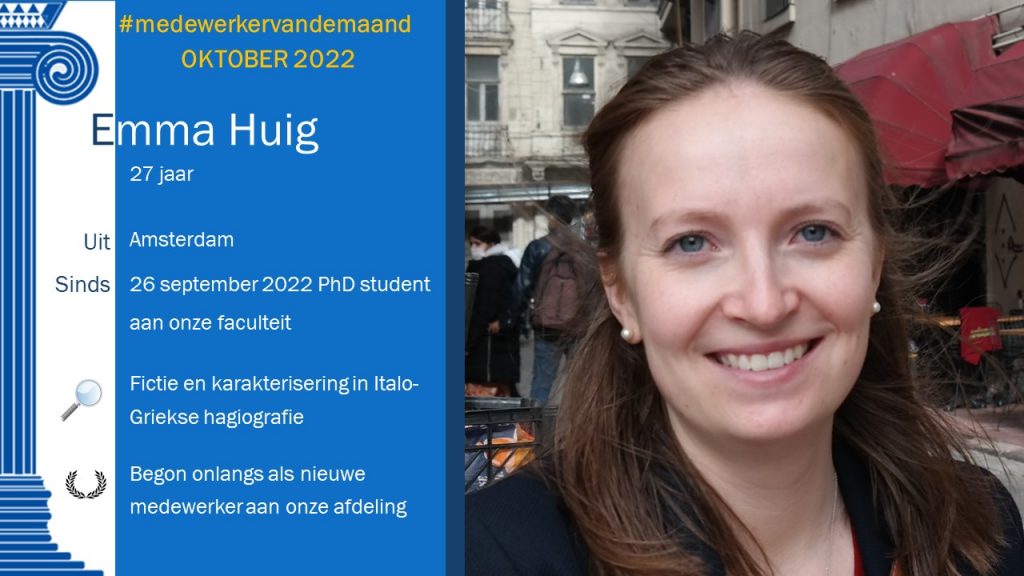
Medewerker van de maand (oktober 2022): Emma Huig

The new academic year has recently kicked off. That usually also means a few new faces at the Blandijn! Emma Huig is one of them. She will be working on her PhD project on hagiography for the next four years. Julie Van Pelt checked in with her to see how she is adjusting to her new environment.

Hello Emma! Good to have you on board as a new PhD student in the Greek section. As a member of the Department of Literary Studies, you will be studying Italo-Greek hagiography, I hear. “Italo-What?”, our readers must think. But first things first: how are you settling in to your new job?

It is very exciting and at the same time a little bit daunting to start this four-year project! Thankfully, everyone at the university has been very kind and welcoming. Personal welcome meetings with my supervisors, meter and the Welcome Office have helped a lot with settling into this new environment. It is also very nice to notice that there is a real sense of community in the office and with other colleagues in the department. I am excited to get started on the PhD-project and to explore everything the university and the city of Ghent have to offer!

After learning that I could start my PhD in Ghent I also got very excited to move to Belgium and to have the opportunity to explore a new cultural and academic environment in Ghent.

About that PhD research, then… Can you tell us a bit more about your project and what you hope to achieve in the next four years?

In the next four years I will be studying Italo-Greek hagiography, Greek texts about saints and martyrs from medieval Southern-Italy and Sicily. I will be looking at aspects of fictionality, a topic which is particularly relevant and interesting in relation to the genre of hagiography. I will do this primarily by looking at the construction of characters in the narratives, for example if and how the saints or martyrs are presented as fictional or historical. I am looking forward to exploring these texts, which have not quite yet received the attention they deserve!

Personally, I hope to of course develop my research skills and also improve my knowledge of some modern languages such as Italian, Modern Greek and Turkish. If possible I would also like to participate in academic and outreach initiatives organised by the department.

Before you came to Ghent, you were doing your MA at Oxford University, and before that, you studied in your home country, The Netherlands. What a journey already! Were you eager to move back to the European continent, and what will you miss about the UK?

During my time in the UK, I was certainly looking forward to moving back to ‘Europe’ and be closer to my hometown of Amsterdam. Most of my family and friends still live there so it is nice that it is now a lot easier to go back to see them. After learning that I could start my PhD in Ghent I also got very excited to move to Belgium and to have the opportunity to explore a new cultural and academic environment in Ghent.

However now I am back on the continent I also miss living in the UK. Especially Oxford will always be a special place where I had some wonderful experiences and met some great people. During the past two years in the UK my partner and I visited quite a few places all over England and Wales and it was so interesting to see all the differences between the regions, and to enjoy the amazing countryside with hills and mountains, which is always special for a person from the Low Lands!

It is very nice to notice that there is a real sense of community in the office and with other colleagues in the department. I am excited to get started on the PhD-project and to explore everything the university and the city of Ghent have to offer!

It is not the first time that a person from the Netherlands joins our team here in Ghent, Belgium. It seems to be somewhat of a recurring experience that the shared language between the two countries proved deceiving, because the Belgian and Dutch cultures are, in fact, quite different. Have you experienced something similar already, and if so, what was the most striking difference to you?

I would definitely agree that the shared language is deceiving, as Belgium really feels different compared to the Netherlands. Perhaps this fallacy of similarity even adds to the sense of alienation, as one is not prepared to experience a culture shock which thereby hits even harder, if that makes sense.

What I have noticed so far in Belgium is the importance of personal contact. I already mentioned the personal welcome meetings I had the first weeks at the UGent, which I think are a good example of this. Dutch society, compared to some countries, is super organised in some areas, sometimes almost a bit too much. Especially in cities like Amsterdam everything follows a certain pattern or rhythm in order for things to be the most efficient. As a result, the personal element can get a bit lost. In Belgium, public spaces can sometimes come across as a bit less uniform, but the importance of personal contact is definitely a positive aspect of this country. Another example related to this are formal lunches. In the Netherlands, the stereotypical ‘business lunch’ is a quick cheese sandwich and a glass of milk at a standing table. In Belgium, I get the sense that going for a formal lunch means a proper meal, sometimes even including drinks. And of course the superiority of Belgian food and drink is another important difference…

We hope that you feel right at home in Ghent, of course! What are the things you like to do in your spare time to make yourself feel at home anywhere?

In my spare time I like being outdoors rowing, cycling, running or walking. These activities also allow one to explore the surroundings. So far I have explored the centre of Ghent on foot, and the areas around the Blaarmeersen and the Bourgoyen-Ossemeersen reserve while running or cycling. I really love both the urban and the natural environments here and I am looking forward to see more!

Thank you for this interview, Emma. We are grateful to have gotten to know you already a little bit better, and we look forward to seeing much more of you and your research in the future. Welcome at UGent!

Medewerker van de maand (september 2022): Marta Capano

We’re not only saying goodbye to summer this month, but also to our beloved colleague Marta Capano, who has been working on the ERC project “Everyday Writing in Graeco-Roman and Late Antique Egypt” since January. Anne-Sophie Rouckhout talked with Marta, to ask her about new adventures, fond memories and an exciting event that took place this month…


Hi Marta! You have been part of our section as a scientific collaborator for the EVWRIT project. Can you tell us a little bit about the work you have been doing?

Hello, and thanks for this opportunity! At Gent, I have been working with the EVWRIT research group, which investigates communication in documentary papyri. With Prof. Klaas Bentein, EVWRIT’s PI, I researched pragmatic functions in the language of Greek papyri, and especially on the link between textualization and speech acts, which means that we want to understand how the writer organized what they wished to express or achieve. For instance, it is very interesting seeing how politeness and making a request interact with each other! You can read very fun papyri from the 1st c. CE where subordinates carefully try to make their bosses do things without being disrespectful!

New adventures ahead, because you have been rewarded a fellowship at the Centre for Hellenic Studies of Harvard University. Congratulations! What research will you be working on there?

Thank you so much! It’s going to be a lot of fun! Here at the CHS I’m conducting my own research project on multilingualism in Sicily in the postclassical period. Basically, I study the choice of inscribing bilingual inscriptions (similar texts in different languages on a single stone) and the social implications of this choice. What does it mean if you have a private funerary stone that is bilingual? And what if there is a public monument with two languages? In addition, I investigate phenomena of language contact with Latin and Punic on seemingly monolingual Greek texts. It’s fun to see how sometimes you can have a monolingual Greek inscription with a lot of language contact, while a public bilingual inscription with two texts that are purposefully “pure”, without any form of contact. Also, the Center for Hellenic Studies has welcomed many Gentenaars over the years, and it is a spectacular place to do research. Check it out on the internet!

I study the choice of inscribing bilingual inscriptions and the social implications of this choice. What does it mean if you have a private funerary stone that is bilingual? And what if there is a public monument with two languages?

We also have another reason to congratulate you, because a little bird told us you got married a few weeks ago – at a medieval cloister, no less! What was that like?

Aw, thank you! It was a truly wonderful, sunny, and happy day! We got married in a former convent in Sestri Levante, Italy, with a lot of friends from many parts of the world. A friend of mine actually married us, and it was a fully bilingual wedding! My husband is an American academic, and just won a Fulbright scholarship to conduct his research in Greece, so we had to separate just a few days after the wedding – we’ll see each other again in two months. Our case is not unique in academia, but it still feels very wrong not to be together. Hopefully, our commitment to our careers will pay off.

Did you find some time for holidays this summer, to take a break from both work and the wedding preparations? Have you been able to plan a honeymoon?

Well, I had to spend some of my vacation dealing with the wedding organization, because marrying a foreigner requires extra bureaucracy, so alas I could not go anywhere else but to my hometown in Liguria. However – as my brand-new husband says – there are worse things in life than spending time in an Italian town on the sea. For the honeymoon, we are thinking of the Dutch Caribbean, possibly Bonaire. I suspect neither of us is yet tired of trying to speak Nederlands (quite poorly, by the way).

I love Belgian food (and drinking) culture, the beautiful Belgian architecture, and the very diverse language landscape.
I find it fascinating how dialects change across a very small geographic area.

Which fond memories will you take with you from Ghent? And what Belgian peculiarity/custom/habit will you miss most?

I am very fond of Ghent! I’d never been to Belgium before coming to UGent, and I immediately fell in love with the University and with Flanders. Ghent University is very open to foreigners, and everyone made me feel at home – I hope to return in the future, also because I miss so many friends already! Outside academia, I love Belgian food (and drinking) culture, the beautiful Belgian architecture, and the very diverse language landscape. I find it fascinating how dialects change across a very small geographic area. In Europe, this is something I’ve seen in only in Italy, and it’s a richness to be very proud of. On a personal level, I will always be fond of the lack of ostentation of the Flemish people, and their love for broodjes! I found myself preparing a broodje here in Washington DC. Let me tell you, it is not the same away from Ghent’s canals and summer light.

Thank you, Marta! Good luck with your research project and enjoy your stay at Harvard University! We hope to see you again soon to have a Gents broodje together!

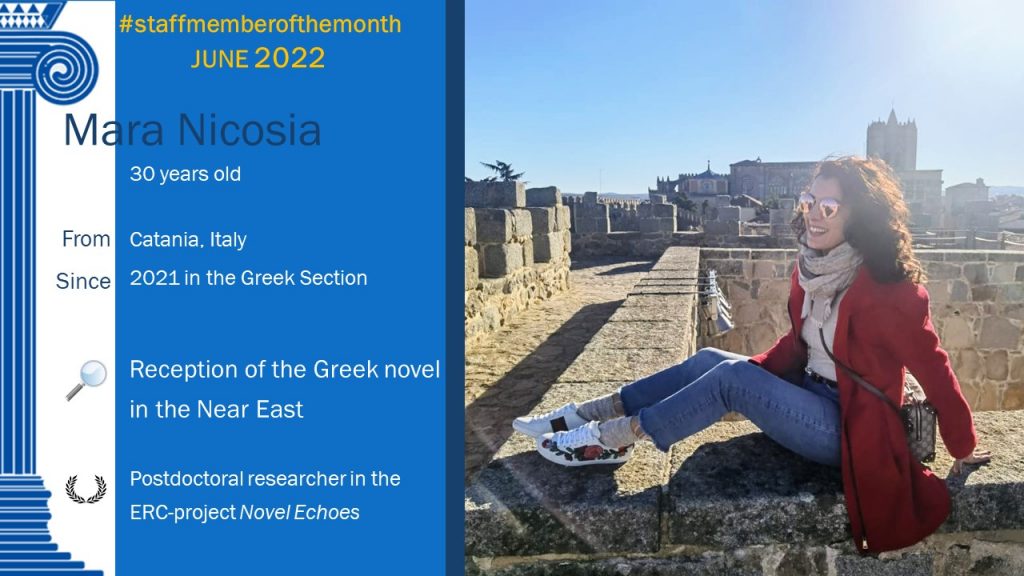
Medewerker van de maand (juni 2022): Mara Nicosia

The staff member of the month of June is Mara Nicosia, who started working for Koen De Temmerman’s ERC-project Novel Echoes as a postdoctoral researcher just over a year ago, and is already making her mark! Evelien Bracke caught up with Mara, to ask her about Syriac studies, working in Ghent, and… visiting Sicily!

Hi Mara, how lovely to speak to you! You’ve been doing some great work on Syriac studies for Koen De Temmerman’s ERC-project Novel Echoes. Can you tell us a little about the work you’re doing?

Yes, of course! As a postdoctoral researcher, I am studying the reception of Greek novels in the Near East, with a specific focus on the Syriac world. Syriac is a variety of Late Aramaic (second-thirteenth centuries CE) that has left an imposing body of literature, together with a huge number of translations from Greek. Surprisingly, though, there seems to be no full Syriac translation of Greek novels, but only two short excerpts from Heliodorus’ Aethiopika in a ninth-century rhetorical treatise. The focus of my research for the past years has been the Syriac rhetorical tradition, so I’m studying these excerpts in the framework of this tradition and its circulation in Syriac schools. Together with my colleague Simon Ford, I have been studying also the Syriac version of another Greek novelistic piece, Pseudo-Nilus’ Narrations, which has been super interesting. I got to study the Semitic toponyms hosted in the Greek and Syriac texts, trying to pin them to a modern location. It has been a lot of fun!

You’re from Sicily! How are you finding living in Ghent – and learning Dutch?

All my life I’ve been living in big or chaotic cities, such as Catania, Naples, Paris, Madrid… Ghent is a most welcome change! I am madly in love with Ghent, it is one of the most charming places I’ve ever been to! In all honesty, I love my Belgian life and I find myself to be enthusiastic about the city, the job and the colleagues!

Learning Dutch has been a pleasant experience for me. I thought it would be a waste of an opportunity living here without trying to learn it, so I managed to get through two levels so far. I am very passionate about languages and I cannot resist the challenge of learning new ones! The only unpleasant note in my Belgian life is that I am systematically experiencing problems with my post: my letters and my parcels always vanish or are lost! This has actually turned into a bit of a joke in the office because I’m always so frustrated at couriers and shipping companies but, despite my many complaints, nothing has changed so far.

I got to study the Semitic toponyms hosted in the Greek and Syriac texts,

trying to pin them to a modern location. It has been a lot of fun!

A little bird tells us you’re getting married soon. How is it combining wedding preparation with research?

Well, I have been more relaxed in my life! Living here and trying to be on top of the preparations in Sicily is exhausting, but ultimately very rewarding. The most stressful part has been respecting all the deadlines I had in May and June, in terms of papers that needed to be submitted, conference presentations and various other engagements. But I’m quite proud of how I managed to prevent myself from panicking too much (so far…). Bottom line: I am very excited about the wedding, so I’m compulsively repeating to myself not to spoil it with unnecessary stress.

One week after the wedding I’ll fly to Paris to attend what I call “the Syriac Olympics”, which is a huge international conference, called Symposium Syriacum, that takes place around the world every four years. This year, I am co-organizing a panel (together with Riccardo Contini) on Syriac lexicography and lexicology, as part of which I’m giving a paper as well. The whole organization has been quite stressful, as the conference was originally supposed to take place in July 2020, but I look forward to it!

Wow, that sounds really exciting! Great to get back to live conferences! What’s the most exciting piece of research you’ve been working on, or are working towards?

Since the beginning of my PhD, I’ve always worked on the acquisition of loanwords from Greek into Aramaic varieties and Arabic, particularly – but not exclusively – in the field of the technical vocabulary of rhetoric. Recently, I’ve moved to the study of the Syriac rhetorical tradition and its “classics”, which has been a big leap. I ventured into a completely new – and severely understudied – line of research, which I find super cool. The idea is to be able to map which texts were used and transmitted in the Syriac rhetorical tradition as examples or progymnasmata, and ultimately which were the authors and works that shaped the Syriac rhetorical tradition, which is imbued with Greco-Roman models but does not seem to be based on Aristotle, and at the same time is very original in themes and organization of the matters.

In all honesty, I love my Belgian life and I find myself to be enthusiastic about the city, the job and the colleagues!

And finally, any recommendations for anyone wanting to travel to Sicily? What are your favourite places?

Sicily is a lovely place to travel to, but my first recommendation would be not to visit it in late July or August because it is too hot and too crowded. Catania is a place worth visiting, as are Palermo, Ortigia, Trapani and others. In my opinion, the best idea is to tour by car around the island and see as many places as one can. Food is definitely worth trying, and we have such a rich Greek and Roman heritage, as well as Phoenician, Arab, and much more, that it is simply impossible to get bored. I’d be happy to help anyone who wants to organize a visit and provide them with useful tips!

I feel a trip coming up for our research group… Thanks, Mara – enjoy the wedding!

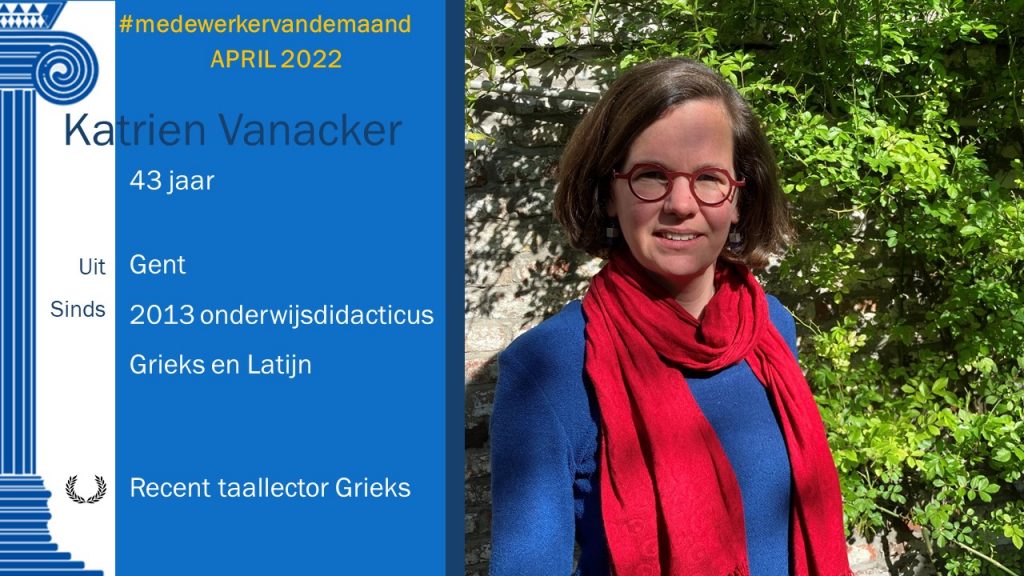
Medewerker van de maand (april 2022): Katrien Vanacker

Onze Medewerker van de maand voor april 2022 begeleidt al jaar en dag met passie en vakkennis de studenten van de lerarenopleiding Grieks en Latijn. Recent ging ze ook als taallector Oudgriekse Taalkunde aan de slag en initieerde een supermooie zomercursus Grieks: het was dringend tijd om meer te weten te komen! Nina Vanhoutte praatte met Katrien – over haar werk, de lerarenopleiding, de koersfiets… en dromen over de zomer. 

Dag Katrien, sinds kort ben je in de vakgroep Grieks aan de slag als taallector: proficiat! Maar je bent geen nieuw gezicht in ons team?  

Klopt, ik heb aan de UGent Grieks en Latijn gestudeerd en ik ging meteen na mijn studies aan de slag als leraar klassieke talen in het secundair onderwijs. Maar in 2013 keerde ik naar de UGent terug als onderwijsdidacticus in de lerarenopleiding, een job die ik sindsdien combineerde met mijn lesopdracht in het Bernarduscollege in Oudenaarde. Ik vorm samen met prof. dr. Katja De Herdt en Wim Cool het kleine en zeer fijne team dat instaat voor de vakdidactiek Grieks en Latijn. Ik ben naast lesgever ook verantwoordelijk voor de stagebegeleiding van de studenten: van de aanvraag van de stages, over lesbezoeken en feedbackgesprekken tot het beoordelen van de stageportfolio’s. De combinatie van beide jobs is heel inspirerend: als leraar Latijn en Grieks blijf ik vertrouwd met de werkvloer en kan ik de studenten veel tips en tricks meegeven, en als onderwijsdidacticus blijf ik het vakdidactisch onderzoek opvolgen en mezelf uitdagen innoverend te blijven lesgeven.  

Toch koos je dit jaar voor nieuwe verantwoordelijkheden. Wat verwacht je van je nieuwe jobs?  

Ik heb dit jaar in mijn school in Oudenaarde een jaar loopbaanonderbreking genomen omdat ik deeltijds aan de Arteveldehogeschool kon beginnen werken als lector Latijn. Toen prof. dr. Floris Bernard me halverwege het jaar vroeg om de oefeningen in Oudgriekse taalbeheersing te geven, ter vervanging van dr. Ilse De Vos, besloot ik ook die sprong wagen. De lesdoelen en leerinhouden verschillen in beide opleidingen grondig van die in het secundair, en dus zijn ook mijn voorbereiding en aanpak anders. Ik lees (voor Vakstudie Latijn in Artevelde) veel meer teksten, ik kan dieper ingaan op de grammatica (de hele Cambridge Grammar of Classical Greek …) en ik mag voor beide talen zelfs de gevreesde themaoefeningen geven! Het zijn nieuwe uitdagingen, die ik voor mezelf als zeer verrijkend ervaar. Ik hoop natuurlijk dat ik met mijn lessen, dankzij mijn ervaring in het middelbaar en in de lerarenopleiding, ook voor mijn studenten het verschil kan maken.  

Aan enthousiasme geen gebrek! Het ontroert me nog steeds te zien met hoeveel passie studenten voor het onderwijs kiezen, ondanks de vaak alarmerende berichten in de media.  

Heb je in de voorbije jaren de lerarenopleiding veel zien veranderen?  

De grootste verandering kwam er in 2019 met de invoering van de Educatieve Master. In de vroegere SLO (of Specifieke LerarenOpleiding) koos een student pas voor een opleiding tot leraar nadat hij of zij het masterdiploma in de taal- en letterkunde had behaald. Maar met de invoering van de EduMA werden wij een geïntegreerd deel van de opleiding en kunnen studenten al vanaf hun derde bachelorjaar kiezen voor het educatieve traject. Dat zorgt ervoor dat wij onze studenten gedurende drie jaar kunnen begeleiden en geleidelijk aan zien groeien bij hun eerste stappen in het onderwijs. Het nijpende lerarentekort zorgt er momenteel wel steeds vaker voor dat onze studenten al tijdens hun opleiding als interimaris aan de slag gaan. Aan enthousiasme geen gebrek! Het ontroert me nog steeds te zien met hoeveel passie zij voor het onderwijs kiezen, ondanks de vaak alarmerende berichten in de media.  

Je bent ook lid van ons Grieks Outreach Team (GOT). Zijn er nog leuke Outreach-projecten waar je momenteel mee bezig bent, die je even in de kijker wil zetten? 

Eind augustus organiseren we een zomercursus Grieks voor toekomstige studenten. We richten ons zowel tot leerlingen die in het middelbaar al Grieks gevolgd hebben, als leerlingen zonder voorkennis Grieks. De enen dagen we uit om hun kennis van de Griekse grammatica grondig op te frissen, de anderen willen we via die eerste kennismaking de kans geven om uit te zoeken of Grieks een studierichting is die bij hen past. Ik kijk heel erg uit naar die week! In de voormiddag geven we lessen in Griekse taalbeheersing en komen collega’s Grieks hun vakgebied voorstellen. Voor de namiddagen heeft de Klassieke Kring een heel leuk programma samengesteld, zodat de toekomstige studenten ook hun studieomgeving en studiegenoten kunnen leren kennen.  

Het zijn nieuwe uitdagingen, die ik voor mezelf als zeer verrijkend ervaar. Ik hoop natuurlijk dat ik met mijn lessen, dankzij mijn ervaring in het middelbaar en in de lerarenopleiding, ook voor mijn studenten het verschil kan maken.  

Met de verschillende jobs die je combineert, kan ik me voorstellen dat je af en toe ook nood hebt aan ontspanning. Waar en hoe kom jij tot rust? 

Met drie zonen van 8, 9 en 12 jaar oud is er altijd leven hier in huis. Ik kan erg genieten van alle familiemomenten samen. Muziek speelt in ons gezin een belangrijke rol: we gaan vaak naar concerten, mijn man staat ook zelf op het podium, en onze kelder is ingericht als repetitiekot waar we musiceren met onze band. Ik sport ook geregeld. Toen ik in Oudenaarde lesgaf, reed ik meestal met de koersfiets naar het werk. Dit jaar heb ik me meer op het lopen toegelegd. Als ik ten slotte ’s avonds moe in de zetel plof, dan doe ik dat het liefst met een boek of handwerk. Maar je kan me ook geregeld bij de buren vinden, want toevallig woon ik naast de gezelligste bruine kroeg van Gent.  

Als afsluiter, waar kijk je nog het meest naar uit dit jaar? 

Een barbecue in de zon, in gezelschap van familie of vrienden, met een goed glaasje wijn, een zomers muziekje op de achtergrond, terwijl ook de kinderen plezier maken. Meer moet dan niet zijn.    

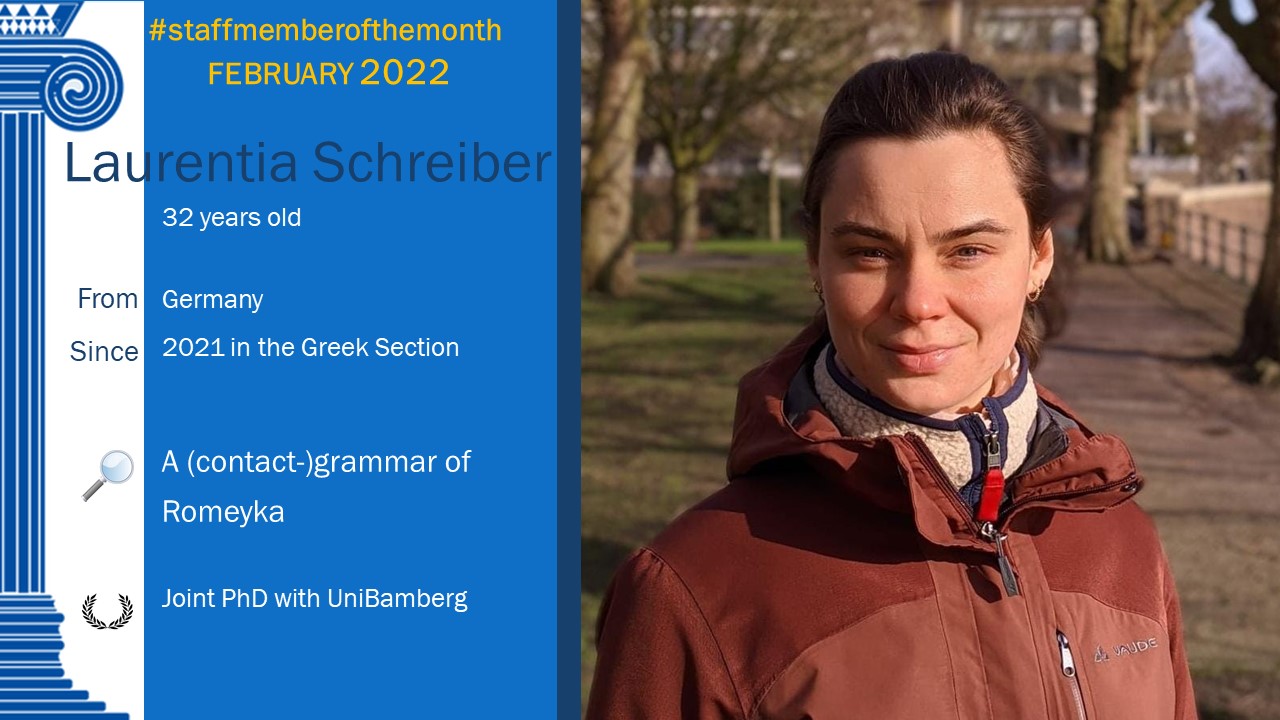
Medewerker van de maand (februari 2022): Laurentia Schreiber

February’s ‘staff member of the month’ is Laurentia Schreiber, who is doing a joint PhD on a fascinating endangered minority language in Turkey called Romeyka. What’s that all about? Serena Causo caught up with her to find out!

Hi Laurentia! You are our special ‘staff member of the month’ for February. You are with us since September 2021 in the context of a joint PhD between UniBamberg and UGent. That must be exciting! We are very curious to know what your project is about and why you chose Ghent University as joint institution for your PhD.

My PhD project aims to provide the first grammatical sketch of the endangered minority language Romeyka, a variety of Asia Minor Greek, which is still spoken by several thousand speakers in a mountainous area in Northeastern Turkey. Intense contact with Turkish and a currently ongoing language shift towards Turkish have led to interesting contact phenomena. At the same time, Romeyka features archaic traits from earlier stages of the Greek language. I am interested in exploring the evolution of synchronic grammatical features that can tell us how language changes under contact conditions and unbalanced bilingualism, which is a threat to many smaller languages of the world. Prof Mark Janse is renowned for his work on Asia Minor Greek, and Cappadocian in particular, so the desire to learn from him about the diachrony of regional varieties of Greek is what brought me to UGent.

I studied Dutch philology at Free University Berlin, and being fascinated with the particularities of Flemish dialects, I discovered my interest in linguistics. So Belgium, and Ghent in particular, mean a lot to me, not only professionally, but personally.

You are very close to the end of your PhD – no pressure! How do you feel? What are the moments you cherish most about this work and life experience?

To be honest, ‘being close to the end’ feels still like a relative statement. I realize that I have come a long way to get here but still there is so much to do. Unfortunately, I should say, I am somebody prone to thinking big, so I anticipate there will be some lessons for me ahead in how to get to the point with things. 🙂 The moments I cherish most during my PhD are probably those which took place in interaction with others: doing fieldwork with speakers in Turkey, traveling for conferences, teaching students, joint publications, … . – And finally, when I come to understand the internal structure of a complex spatial expression at the end of a day, that’s a nice feeling as well.

Romeyka features archaic traits from earlier stages of the Greek language. I am interested in exploring the evolution of synchronic grammatical features that can tell us how language changes under contact conditions and unbalanced bilingualism, which is a threat to many smaller languages of the world.

We know you are half way your experience in Gent. How has it been so far? Is your research benefitting from your stay?

Till now it has been a very enjoyable time here in Ghent – despite the limitations due to the pandemic: I enjoy the international, historical, cultural, and creative city and its people, and there is still enough time to focus on my work. In sum, I think the research stay took my dissertation to a different level with so many new insights. Now for the remaining time, I will need to wrap up and see how things can be integrated. However, the highest value of this stay is probably a personal one: I gained a lot of inspiration, but also focus, and new dynamics.

Now a warning: our favorite questions are always the most personal ones! It must be exciting and yet quite challenging to move to a new city – especially during this weird time. Have you fallen in love with the city yet? What are your favorite corners?

Actually, Ghent is not new to me as I was fortunate enough to spend my European voluntary service here back in 2009. As a consequence, I studied Dutch philology at Free University Berlin, and being fascinated with the particularities of Flemish dialects, I discovered my interest in linguistics. So Belgium, and Ghent in particular, mean a lot to me, not only professionally, but personally. I am very thankful for having been granted a chance to come back, tie onto earlier experiences, and make new ones. I still see some old friends, but can also continue my current hobbies like horse riding. And finally, there are so many beautiful places around for having a walk. For example, I enjoy a lot the open atmosphere of the harbour scenery of Portus Ganda right at the end of my street.

Thank you, Laurentia! We are so pleased to have you here and that you are enjoying your time in Gent. We wish you the best of luck with your work!

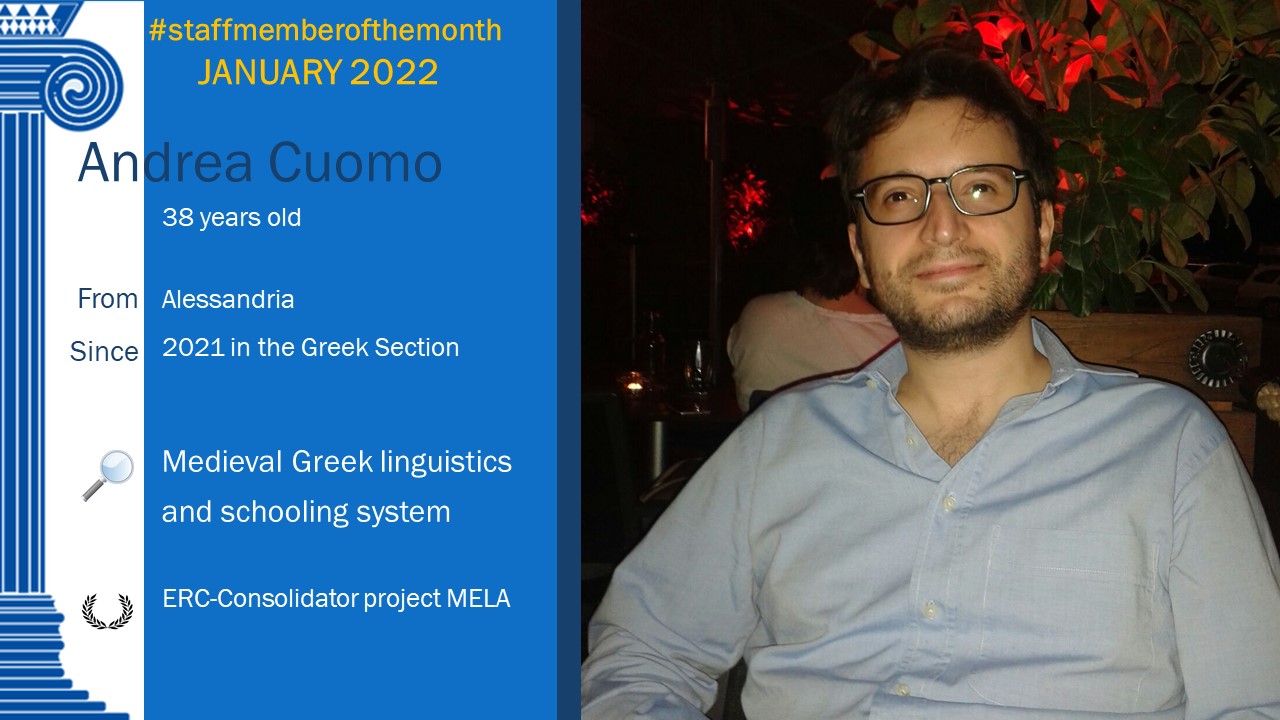
Medewerker van de maand (januari 2022): Andrea Cuomo

We’re delighted to introduce our staff member of this month, Professor Andrea Cuomo. Andrea joined our department from the Austrian Academy of Sciences with an exciting new research project funded by the European Research Council. Nina Vanhoutte asked him about his research, settling in Ghent, and his love for music. 

Hi Andrea! You have been part of our team since October 2021, and your ERC-project “MELA. The MEaning of LAnguage: A Digital Grammar of the Greek Taught at Schools in Constantinople” starts in January 2022. Can you tell us a bit more about the project?

Hey Nina, correct! I have worked here in Ghent for four months now: taught my first classes here, took my first Dutch classes, engaged with students and colleagues, and started laying the ground for MELA, which began a few days ago… So many firsts!

The acronym MELA stays for the ‘meaning of language’. Everything originated from my interest in knowing what Medieval Greek meant to the medieval author. My project focuses on the last period of the Byzantine Empire, the so-called Palaeologan era (1262–1453). After the 1261 Byzantine reconquest of Constantinople, the City and other civil and cultural centres such as Thessalonike and Trebizond thrived admirably. The study of law, theology, literature, philosophy and the natural sciences flourished, and studies on grammar followed a similar trend. Particularly in the capital, intellectuals such as Maximos Planoudes, Manuel Moschopoulos, Theodore Metochites and Nikephoros Gregoras produced textbooks whose impact was felt even during the Western Renaissance.  The aim of my project MELA is to recover the grammatical knowledge of the Byzantines, as we can find them in the textbooks of the time, and organize them within the framework of a digital grammar. In my vision, after MELA’s conclusion, we will be able to consult the ‘grammar book that the Byzantines consulted’ and thus have a less anachronistic understanding of their literature. We will have a clearer understanding of the surviving manuscripts transmitting medieval textbooks. We will have the Digital Grammar that effectively enables more focused linguistic studies, and that facilitates studies on the transformation of linguistic norms over time, on the impact of language training, and on medieval language use. We will have a starting point for new research affecting linguistics and hermeneutics in general.

As you can imagine, this is by all means not a one-man-show: 15 textbooks, over 600 manuscripts… So many sources to be analysed from the viewpoint of philology, palaeography, historical linguistics, and the digital humanities! So, you can understand the current delicate phase of my project: recruiting my team. I just advertised a couple of vacancies: by the end of the year, we are going to welcome five new PhD students in Ghent, and by the end of next year, two post-doctoral researchers are going to contribute to MELA.

It is rather useful to understand how we came to know what we know and why it is useful to know what we know. This reminds me of an Italian saying that goes:

“It is not good enough that you are right: you also need to find someone who agrees that you are right”.

That sounds very exciting – good luck with the hiring process! What would you say are the most important ingredients for a successful project?

Firstly, I would say: Curiosity, a sense of duty, focus (which also implies necessary funds and time to be able to work), and clear ideas. For me, it is also important that the work is conceived as team work without careerism that transforms the beautiful spirit of academic research into a cynical bloodbath.

Last but not least, notionism is a danger to be avoided. I hope to agree with the collaborators that it is not useful to accumulate notions, pieces of knowledge, nor to lose the link between the single notion and the general picture. In fact, it is rather useful to understand how we came to know what we know and why it is useful to know what we know. This reminds me of an Italian saying that goes: “It is not good enough that you are right: you also need to find someone who agrees that you are right”. We can rephrase it and say: “It is not enough that you know something, if you do not know where this knowledge comes from, nor how to share it with others”.

I discovered that the students are very mature and it is possible to establish an engaging dialogue with them. Generally, in our department, I have noticed that there is an amazing group of researchers of all ages who exchange on numerous issues. It is a great joy for me to come to the Blandijn and meet with my colleagues!

How has your experience in Ghent been so far? What are some of the things you have discovered and – hopefully – liked?

So far, my experience here in Ghent has been very intense: there were many new things to learn … I still can’t believe the huge opportunity that was given to me! I found that Ghent is a very dynamic city and much more international than I expected. This is great, because I imagine I will have a lot of inspiration and will learn a lot. Furthermore, I discovered that the students are very mature and it is possible to establish an engaging dialogue with them. Generally, in our department, I have noticed that there is an amazing group of researchers of all ages who exchange on numerous issues. It is a great joy for me to come to the Blandijn and meet with my colleagues!

Life isn’t all work, of course. What do you like to do when you’re not working or teaching?

I play the piano and love playing music with other people. Also, I like sharing beautiful days with friends cooking or in nature (hiking, skiing, walking). I love those days when nothing is planned and anything can happen. Once, after a few drinks, a friend of mine and I planned to take off and visit Australia. We did it: a week later, we were on the other side of the world…

Lastly, let’s kick off this year on a positive note: what are your hopes, predictions or resolutions for 2022?

Predictions? Hm, I just don’t know how to make predictions. Resolutions? Well, this is frustrating, because I never do what I plan to do: I change plans all the time. Maybe I have a few wishes… First of all, I hope that the pandemic ends or rather that some silly reactions that are connected with the pandemic end. We all, and especially young people, have to travel, meet, touch, eat frites with dirty hands… As for my life: I wish to always keep a certain “attitude of a beggar” towards life, to always be curious. Sometimes I’m afraid that comforts and easy answers may distract me from this thirst for meaning which, to be honest, seems to me unquenchable.

Thanks, Andrea! Good luck with your wonderful research. We’re looking forward to hearing you play the piano some time soon!

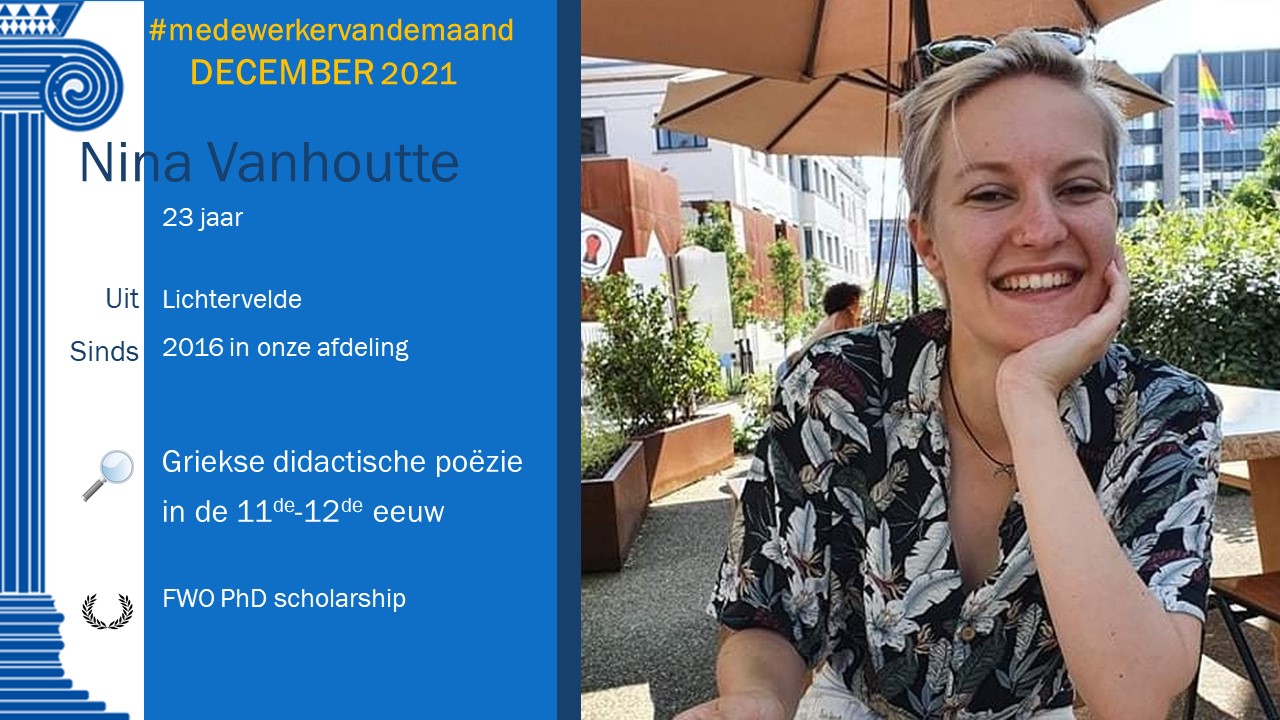
Medewerker van de maand (december 2021): Nina Vanhoutte

Deze maand zetten we Nina Vanhoutte in de kijker: ze is een rasechte UGent’er en startte net een fascinerend FWO-doctoraat over Griekse didactische poëzie in de 11de en 12de eeuw. Hoe ervaarde ze de overgang van masterstudent naar doctoraal onderzoeker in coronatijden? Serena Causo ging het haar vragen.

Hey Nina! Jij bent onze medewerker van de maand omdat we je fantastische prestatie willen vieren: je kreeg in 2021 een FWO-mandaat voor je doctoraatsscriptie. Proficiat! Kan je ons wat meer vertellen over je project?

Ja, ik ben heel blij! Ik ben in oktober 2020 begonnen met mijn doctoraat op de BOF-beurs van professor Floris Bernard, mijn promotor. Nu heb ik echter mijn ‘eigen’ beurs in de wacht gesleept, waar ik uiteraard trots op ben! Het voelt ook een beetje als een nieuw begin, omdat ik mijn onderwerp wat uitgebreid heb in het afgelopen jaar, en naar mijn gevoel is mijn project nu nog sterker geworden.

Mijn onderzoek gaat over Griekse didactische poëzie in de 11de en 12de eeuw, dus in de Byzantijnse periode. Ik zal zeven gedichten van de auteur Niketas van Herakleia voor het eerst uitgeven, vertalen en analyseren, en dit combineren met een bredere studie van de kenmerken van dit genre in de 11de en 12de eeuw. Het wordt dus een uitdagende combinatie van paleografie, filologie, vertalen, literaire analyse en het bestuderen van de socio-culturele context, wat ik helemaal zie zitten!

De mooiste momenten blijven voor mij simpel: studiedates met vrienden, koffiepauzes tussen de lessen, snuisteren in de bib, samen stressen over examens en dan ook samen vieren wanneer we slagen…de kleine dingen in het leven!

Spannend! We kijken er naar uit je editie te lezen! Je PhD startte in het Coronajaar en je bent een PhD-student van de C-generatie. Hoe heb jij dat ervaren?
Fantastisch dat hier een woord voor bestaat. Het was heel vreemd om te starten aan een doctoraat in Corona-tijden. Ik heb het einde van mijn Master afgewerkt in hetzelfde jaar, wat al moeilijk was, maar om dan meteen aan een doctoraat te beginnen was zowel een zegen als een uitdaging. Ik was heel blij om een vaste job te hebben en iets waar ik kon op focussen in onzekere tijden, maar tegelijkertijd voelde ik me heel geïsoleerd door acht maanden thuis te werken. Het was een grote aanpassing omdat ik plots geen echte ‘structuur’ meer had, zoals lessen of regelmatige deadlines & examens, maar gelukkig had ik wel regelmatig contact met mijn promotor en met mijn collega’s, al was het dan vaak online. Het grootste voordeel voor mij was dat ik ook veel thuis bij mijn ouders kon gaan werken, iets waar zowel zij als onze lieve hond Beer heel blij mee waren. Al bij al heb ik veel geleerd in het afgelopen jaar, en ik voel me nu een sterkere persoon en onderzoeker!

De UGent heeft je zien groeien van bachelor- naar masterstudent en nu onderzoeker op doctoraatsniveau. Wat zijn de hoogtepunten van je carrière hier?

Ik kan moeilijk geloven dat het al vijf jaar geleden is dat ik begon aan de UGent! Ik heb zoveel interessante mensen leren kennen, sommigen daarvan zijn heel goede vrienden geworden. Ik ben lid geweest van de Klassieke Kring en heb ook een jaartje in het praesidium gezeten: hun activiteiten waren lange tijd een hoeksteen van mijn sociaal leven. Mijn Erasmus-semester in de derde bachelor was voor mij een fantastische ervaring, ik ben er enorm door gegroeid en ik heb er ook een aantal dichte vrienden aan overgehouden. Ook de verschillende vakken en proffen die ik gehad heb, hebben hun invloed op mij achtergelaten. Het is fijn dat ik hen nu collega’s mag noemen.

De mooiste momenten blijven voor mij echter simpel: studiedates met vrienden, koffiepauzes tussen de lessen, snuisteren in de bib, samen stressen over examens en dan ook samen vieren wanneer we slagen…de kleine dingen in het leven!

Ik hou ook enorm van de Plantentuin en het Citadelpark. Ik ben het nog steeds niet helemaal gewoon om in een drukke stad te wonen, dus even tussen het groen zitten helpt me vaak om tot rust te komen.

Na zoveel jaren in het onze geliefde Gent ken je het waarschijnlijk wel goed. Kan je je speciale plaatsjes met ons delen (en eventueel het adres van je fantastische kapper)?

Met veel plezier! Ik heb een voorliefde voor gezellige koffiebars, zoals Miss Leia aan de Oude Houtlei, dat was mijn favoriete plekje het afgelopen jaar. Mijn favoriete restaurant als ik nood heb aan comfort-food is The Indian Curry-House, de familie die het uitbaat is enorm vriendelijk en hun eten is fantastisch. Verder heeft ook het hondencafé Dogs & Drinks een speciaal plekje in mijn hart, aangezien we onze hond Beer bij hen geadopteerd hebben. Ik hou ook enorm van de Plantentuin en het Citadelpark. Ik ben het nog steeds niet helemaal gewoon om in een drukke stad te wonen, dus even tussen het groen zitten helpt me vaak om tot rust te komen.

Mijn kapster zit spijtig genoeg niet in Gent, maar in Torhout, West-Vlaanderen. Als je ooit in de buurt bent, spring zeker eens binnen bij The Haircrew Barbershop! Zeg maar dat ik je gestuurd heb 😉

Bedankt, Nina! Alvast succes met je doctoraat! We komen elkaar alleszins in één van je favoriete plaatsjes tegen!

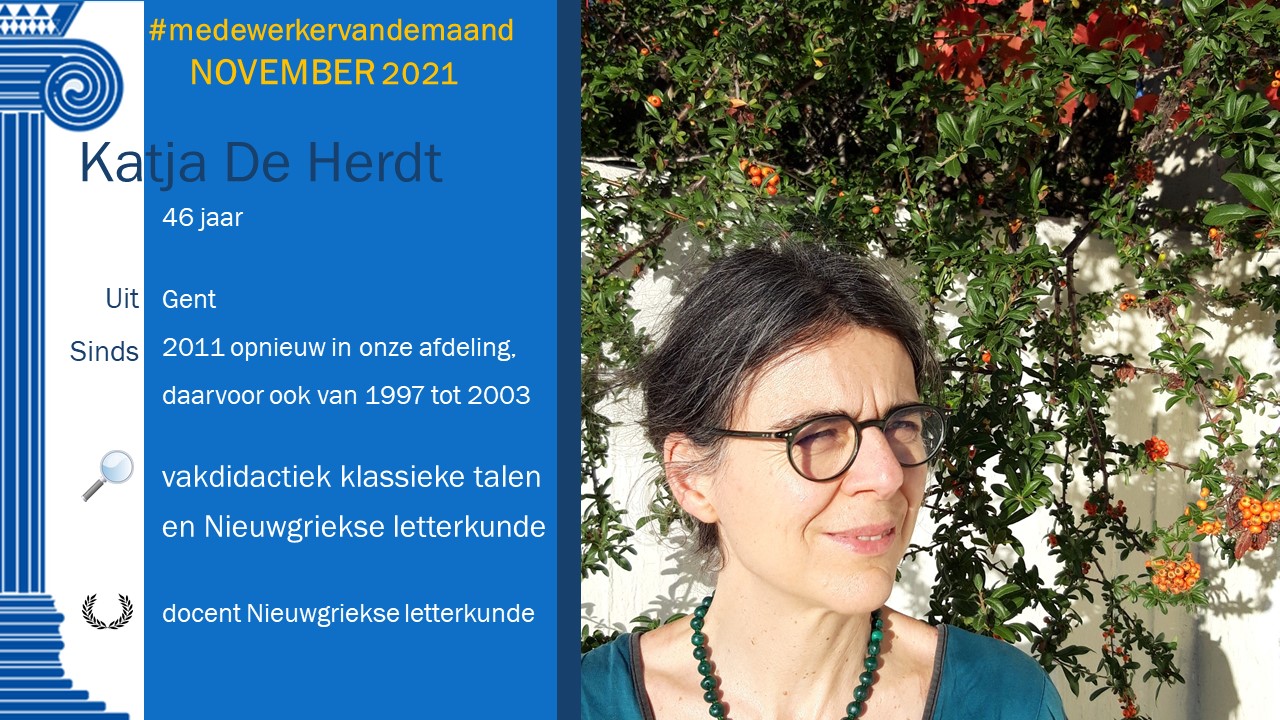
Medewerker van de maand (november 2021): Katja De Herdt

Professor Katja De Herdt hoeft voor onze studenten geen introductie: alle kersverse leerkrachten Latijn & Grieks die afstuderen aan de UGent, worden door haar met zorg en aandacht opgeleid! Nu ze een tijdje geleden ook docent Nieuwgriekse taalverwerving en letterkunde werd binnen onze afdeling, was het dringend tijd om haar even in de schijnwerper te zetten. Haar doctoraatsstudente Alexandra Vereeck stelde haar dan ook graag enkele vragen:

Dag Katja, we zijn heel blij wat meer te horen over je functies aan de UGent. Je combineert twee vakgebieden, vakdidactiek klassieke talen en Nieuwgrieks. Op zijn minst origineel! Hoe ben je tot deze niet alledaagse combinatie gekomen?

Toen ik op de middelbare school zat, had ik nooit gedacht dat ik me ooit zou bezighouden met didactiek. Ik heb lang getwijfeld of ik klassieke dan wel moderne talen zou gaan studeren (dat het talen zouden zijn, wist ik al heel lang). De mogelijkheid die het toenmalige UGent-curriculum klassieke talen bood om een driejarig traject Nieuwgrieks te volgen, heeft me over de streep getrokken om dan toch voor klassieke te kiezen. Uitsluitend dode talen studeren (hoe graag ik er ook mee bezig was), vond ik toch een gemiste kans. En de afstand die ik ervaarde tussen mezelf en de schrijvers uit de Oudheid leek moeilijk te overbruggen. Bovendien was ik ondertussen al verliefd geworden op het Nieuwgrieks, dankzij Assimil, een laatstejaarsreis en een zomercursus in Athene. De passie voor het moderne Griekenland heeft me nooit meer losgelaten! Na een Erasmusjaar volgden als vanzelf een masterthesis en een doctoraat met focus op de Nieuwgriekse taal- en cultuurgeschiedenis. Maar het leven neemt soms rare sprongen. Na mijn doctoraat kreeg ik in 2004 de kans om een curriculum Latijn uit te bouwen in de professionele bacheloropleiding leraar secundair onderwijs (het ‘regentaat’) van Arteveldehogeschool. Daar ben ik toen voluit voor gegaan. Plots was ik niet meer bezig met vergeten (edoch zeer intrigerende) Griekse intellectuelen uit het tijdvak 1860-1910, maar met de vraag welke Latijnse auteurs in zo’n curriculum passen en ook, wat de meest efficiënte manier is om twaalfjarigen de Latijnse genitief aan te leren. Ik heb toen veel gestudeerd en geleerd, ook uit observaties en ook uit gesprekken met leerkrachten. Die vakdidactische expertise bracht me zes jaar later terug naar de UGent voor een deeltijdse aanstelling als ZAP voor het domein vakdidactiek klassieke talen. Na het emeritaat van Gunnar De Boel kwam daar ook Nieuwgrieks bij en zo is de cirkel rond.

De passie voor het moderne Griekenland heeft me nooit meer losgelaten! Na een Erasmusjaar volgden als vanzelf een masterthesis en een doctoraat met focus op de Nieuwgriekse taal- en cultuurgeschiedenis.

Heeft het feit dat je ook een levende taal onderwijst impact op de manier waarop je de didactiek van de oude talen benadert?

Ik kan niet zeggen dat ik sinds vorig jaar andere accenten leg in mijn cursussen vakdidactiek. Wel heb ik vier jaar geleden een enorme sprong gemaakt in mijn denken over (en mijn beleving van) Latijnse taalverwerving. Ik heb toen een zomercursus levend Latijn gevolgd bij topleraar Casper Porton (addisco.nl) en er is een wereld opengegaan. Na enkele uren immersie bleek het niet onoverkomelijk moeilijk om Latijn te spreken – alsof jarenlang afgesloten lades in de kasten van mijn brein één na één opensprongen. Voordien leek Latijn spreken me behoorlijk absurd en was ik ook nogal vies van zelfgeschreven Latijn. Ik ben me dan gaan verdiepen in de zogenaamde communicatieve methode en het onvolprezen handboek Familia Romana van Hans Oerberg. Ondertussen ben ik ervan overtuigd dat ook voor klassieke talen een natuurlijke, meer impliciete manier van taalverwerving heilzaam kan zijn, zeker voor heterogene groepen en voor leraren die graag met handen en voeten lesgeven. En dat leerlingen op deze manier met minder moeite woordenschat en tekstbegrip verwerven, staat voor mij als een paal boven water. Maar dé beste methode om oude talen te onderwijzen, bestaat natuurlijk niet. Dat probeer ik ook aan de studenten vakdidactiek mee te geven: kijk kritisch naar elke methode, durf experimenteren en doe datgene waar je goed in bent. Maar bovenal: besef dat het gevaarlijk is om de manier waarop je zelf Latijn of Grieks hebt geleerd tot norm te verheffen.

En omgekeerd: geef je anders Nieuwgrieks omdat je ook – bewust – bezig bent met didactiek?

Dat zal je aan de studenten van Ba2 moeten vragen! Hoe dan ook verschilt mijn aanpak – denk ik – grondig van die van mijn voorganger. De passie is dezelfde, maar de invalshoek verschilt.

Het feit dat ik aan de hogeschool ook Latijn geef (taal, literatuur, cultuur) doet me als vakdidacticus steviger in mijn schoenen staan. Tegelijk daagt de academische insteek van de universiteit me voortdurend uit tot verdieping.

Hoe is het om een aanstelling aan de UGent te combineren met een aanstelling aan Arteveldehogeschool?

De boutade dat 1+1 meer is dan 2, klopt natuurlijk: twee mailboxen, twee vergaderagenda’s, twee (deels) verschillende semesterindelingen opvolgen vraagt veel tijd en een strakke planning. Daar komt nog bij dat ik me aan de UGent in en tussen verschillende entiteiten beweeg: de afdeling Grieks, de afdeling Latijn, de vakgroep Letterkunde, de groep vakdidactici van de verschillende talen en, last but not least, mijn “dagelijkse” collega’s van teams vakdidactiek L&G (Katrien Vanacker en Wim Cool) en de Griekse lector Evanthia Kaskadiri.  Aan de Arteveldehogeschool, waar ik een grotere aanstelling heb, is het landschap gelukkig een stuk overzichtelijker. Inhoudelijk vind ik het een grote meerwaarde om beide jobs te combineren. Het feit dat ik aan de hogeschool ook Latijn geef (taal, literatuur, cultuur) doet me als vakdidacticus steviger in mijn schoenen staan. Ook heb ik er veel praktische knowhow meegekregen rond bij voorbeeld stagebegeleiding en competentiegericht evalueren. Tegelijk daagt de academische insteek van de universiteit me voortdurend uit tot verdieping.

Waar hou je je zoal mee bezig als je niet op de Blandijnberg of de Kattenberg vertoeft?

Nu ik niet meer in Gent woon, is het eerste wat bij deze vraag in me opkomt: fietsen (van en naar huis). Voeg daar aan toe: werken in de tuin – een late roeping, die me zeer veel voldoening geeft. Kilo’s bladeren bijeen harken in een herfstige tuin is meditatie in actie. Ja, ik wijd me ook aan yoga, zij het dan nogal onorthodox (liever snel tussendoor op blote voeten in de tuin, dan in een sportieve outfit in een trainingzaal). Mijn dochters zien opgroeien. Dromen van een mondmaskervrije vakantie in Griekenland. En lezen natuurlijk, al maak ik daar veel minder tijd voor dan ik zou willen.

Klinkt zalig. We wensen je nog veel plezier in je tuin – en hopelijk eens tijd voor een extra boek of twee!