Medewerker van de maand (november 2024): Elpida Konia

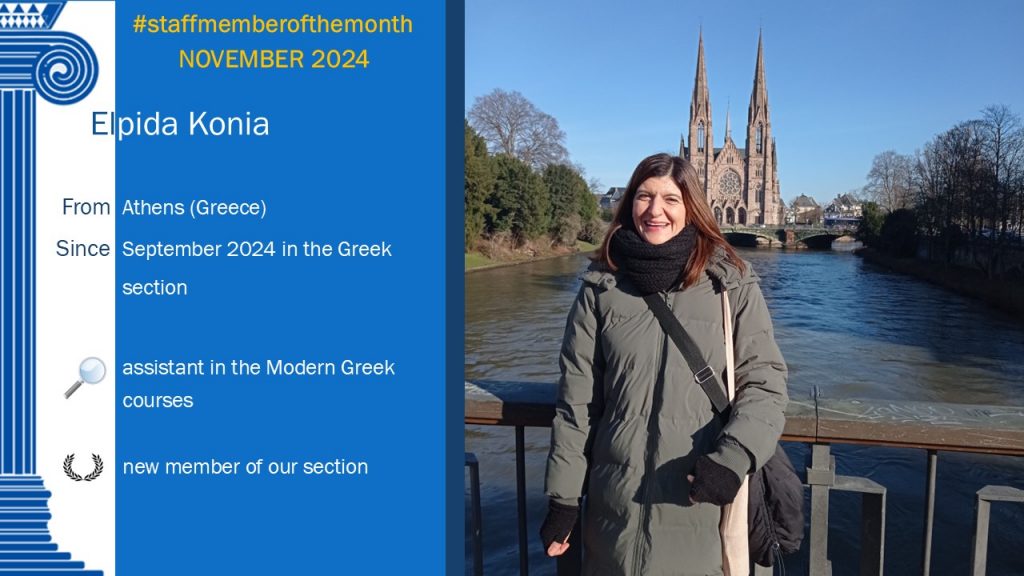
The staff member of this month is Elpida Konia, who started working with us in September 2024, as an assistant in the Modern Greek courses. Elpida recently moved from Athens to Brussels as seconded teacher, paid by the Greek Ministry of Education. Katja De Herdt asked Elpida about her teaching experiences, her research on young adult literature and much more.
Hi Elpida! On Mondays you teach Ancient Greek and History to Greek teenagers at Kestekidio Hellenic School in Brussels, next day you’re working with Flemish students in Modern Greek. Which part of your job is most challenging?

Well, what I am actually experiencing is a demanding but fascinating teaching schedule. Maintaining student motivation can be a significant challenge in both contexts. Greek teenagers often feel disconnected from Ancient Greek texts because they are distant both in time and language. While Ancient Greek is part of their cultural heritage, they may not see its immediate relevance to their daily lives. As a result, maintaining my adolescent students’ interest in the subject can be difficult and requires insight and creativity. That said, while both parts of the job present unique challenges, teaching Modern Greek to Flemish students could be considered the most challenging because of the language barrier and the cultural distance between the students and the subject. However, an unexpected yet inspiring aspect of my current teaching experience is Flemish students’ prior knowledge of Ancient Greek and their keen interest in Greek culture which brings energy and vibrancy to our lessons.

You have been living in Brussels for 1,5 years now, after quite a few decades in Athens. You are passionate about Athens. Do you have the same πάθος with Brussels? How do you spend your weekends in our capital?

I am absolutely passionate about your capital. I chose to live in Brussels because of its reputation as the heart of Europe. Over the past year, I have experienced a city that is as welcoming as it is fascinating, blending historic elegance with modern vibrancy. I truly appreciate its contemporary, multicultural vibe, as well as the old buildings that tell stories of a rich past. Beyond the city, the beautiful Belgian countryside offers stunning landscapes and charming villages, perfect for peaceful escapes. On weekends, I often find myself exploring the lush parks, the bustling neighborhoods and the wonderful museums of the city. Moreover, one of the things I love most about my life in Brussels is that I’ve been able to incorporate jogging and cycling into my daily routine.

What I find quite surprising is that I often shiver while Belgians stroll comfortably in shorts or light jackets. It seems Belgians have a remarkable resilience to cold weather.

If you have to name one weird habit of Belgian people, what would it be? No worries, we can take it! Could you imagine living in Belgium for the rest of your life?

By all means, I can imagine living here for a long time. I have great admiration for the Belgian way of life, which embraces health and well-being—cycling through scenic routes, jogging in lush parks, or simply enjoying outdoor activities. However, since you asked, what I find quite surprising is that I often shiver while Belgians stroll comfortably in shorts or light jackets. It seems Belgians have a remarkable resilience to cold weather. I suppose this habit comes from a practical approach to the unpredictable climate and the sudden changes of the weather. I’ve even heard some locals joke that as long as the sun is out, it’s “warm enough,” no matter the actual temperature.

In 2016 you finished a PhD on Modern Greek Literature. Why did you choose this topic and what should we know about it?

My passion for the Greek language and culture has been a driving force throughout my academic journey. I have dedicated both my undergraduate and postgraduate studies to linguistics and philology, and I have developed a deep appreciation for the complexities and nuances of the Greek language. However, as my career progressed, my interests began to evolve in response to my experiences as a teacher in secondary education. While teaching adolescents, I became increasingly aware of the power of literature to engage young minds and influence their personal and intellectual growth. This realization sparked a new direction in my research, prompting me to explore the field of contemporary Greek young adult literature. While my initial academic focus had been on traditional linguistic and philological studies, I now found myself drawn to the narratives that resonate with younger audiences, exploring how these texts can be a means of both cultural expression and psychological exploration.

While teaching adolescents, I became increasingly aware of the power of literature to engage young minds and influence their personal and intellectual growth. This realization sparked a new direction in my research, prompting me to explore the field of contemporary Greek young adult literature.

On which days and where can we find you at Blandijn, to have a nice talk on Greek literature or biking in Flanders?

You can usually find me at Blandijn on Tuesdays and Fridays where I am either teaching or working on lesson plans. My (shared) office is 05.03.120.027 on the 2nd floor. I’d love to have a nice chat about Greek literature or share some biking tips in the region. Just let me know when you’re around, and we can grab a coffee and dive into whatever topic you’re most excited about—whether it’s discussing the beauty of Homer’s epics or the best cycling routes around Ghent! Looking forward to it!
Medewerker van de maand (oktober 2024): Eleonora Lauro

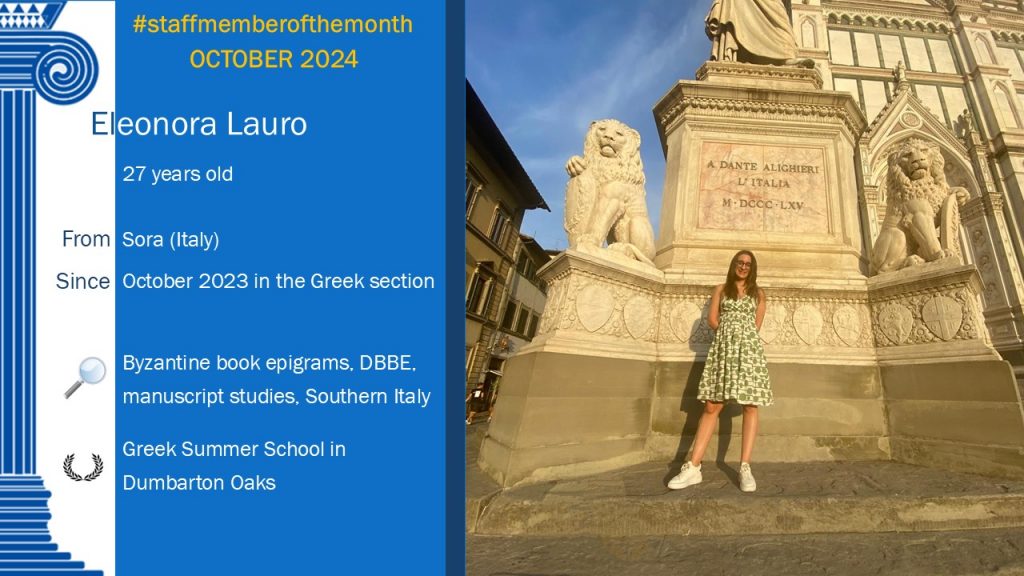
The staff member of this month is Eleonora Lauro who started her PhD with us in October 2023 after completing her BA and MA at the Università degli Studi di Roma Tor Vergata. Nina Vanhoutte asked her about her research, hobbies and her first year in Ghent.

Hi Eleonora! You started a PhD in our Section last year, on the DBBE-project, do you want to tell us a bit more about your research?

Hi! I would love to share more about my research. Within the “DBBE” framework, I am currently working on the “book culture subproject”, which aims to explore the socio-cultural entanglement of book epigrams. These metrical paratexts offer interesting insights into the interaction between scribes/readers/patrons and the manuscripts themselves. Specifically, my research focuses on manuscripts produced in medieval Southern Italy. The goal is to highlight how individuals and communities in this region used book epigrams to express their relationship with the main texts. Of course, the database and its technologies have been incredibly helpful, giving me quick access to a wide range of data and metadata.

Can you tell me about your experience at the Greek Summer School in Dumbarton Oaks? What were some highlights or key takeaways from that time?

My one-month stay at Dumbarton Oaks for the “Greek Summer School” was an intense but wonderful experience. The program included group translation sessions, palaeography exercises and individual tutorials, so we were on a tight schedule, but every moment was worthwhile. I learnt a lot, especially thanks to the instructors – Prof. Stratis Papaioannou and Prof. Alexandros Alexakis –, who were always willing to help and guide us through the material. My companions during this adventure – the other participants – were definitely one of the highlights of my time at Dumbarton Oaks!  We exchanged stories and advice about our respective PhD journeys, and we genuinely enjoyed spending time together. Our outing to see the fireworks for the Fourth of July is one of my favorite memories. Visiting the Library of Congress was also a dream come true for me!

My research focuses on manuscripts produced in medieval Southern Italy. The goal is to highlight how individuals and communities in this region used book epigrams to express their relationship with the main texts.

You’ve lived in Ghent for about a year now, what are your favourite things about living here?

It’s been a wonderful year living in Ghent! It’s a beautiful city, and I really love how its rich history and lively modern culture blend together.  There are always interesting activities and initiatives to take part in. For example, the Film Fest Gent, which has been going on for the past two weeks, is an amazing event that has brought me back to the cinema after a long time!

I heard you make a great Pasta Amatriciana – is cooking your main hobby outside of work? Or how do you spend your downtime?

Who has been spreading this false rumour? Clearly, they have never had a properly cooked Amatriciana! Jokes aside, I do my best in the kitchen, but it’s not really my realm! Cooking is more a necessity than a fun activity for me. When I have some downtime (and the weather allows it), I like to go to the Groe­ne­val­leipark, which is very close to where I live. I enjoy walking around the park or sitting on a bench there to catch up on some reading. I have also recently rediscovered my love for movies, so I have been going to the cinema more often lately. As you can tell, I enjoy the simple life!

I enjoy walking around the park or sitting on a bench to catch up on some reading. I have also recently rediscovered my love for movies, so I have been going to the cinema more often lately. As you can tell, I enjoy the simple life!

What are you most looking forward to in the upcoming years?

I look forward to making significant progress with my research and sharing my results through publications and conferences. I also hope that the next years will bring exciting opportunities to engage with international peers, deepen my expertise in the field of Byzantine studies, and enhance interdisciplinary collaboration. Overall, I see these next few years as a chance for both personal and professional growth – and hopefully, a culinary breakthrough as well!

“Goede vooruitzichten”, as we would say in Dutch! And if you do become a master chef, please let us have a taste!

Medewerker van de maand (juni 2024): Isabelle de Meyer

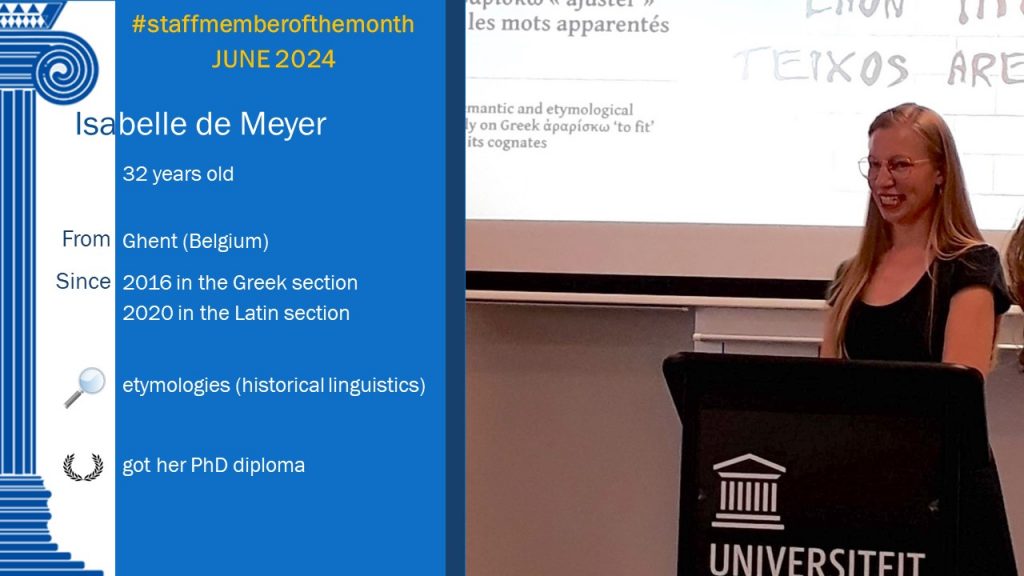
The staff member of this month is Isabelle de Meyer, who successfully defended her joint PhD thesis in Historical Linguistics (Ghent University – Ecole Pratique des Hautes Études) a few weeks ago! Yasmine Amory took this perfect occasion to take a journey with Isabelle on ancient etymologies, and much more.


Hi Isabelle! First of all, my biggest congratulations on a great personal and professional achievement: your recent PhD defense! How do you feel these days? Is the adrenaline still on?

Thank you so much! The days after my defence were, erhmm, well, let me explain it this way: after having motivated myself for months by thinking of Dory, the fish from the Disney movie Finding Nemo, singing “just keep swimming, swimming”, I suddenly felt like the fish at the end of the same movie when they finally reach the ocean and say: “now what?”. But I am starting slowly to find a new routine and the adrenaline has been replaced by enjoyment, which is great.

You are probably the ‘panda’ of Greek linguistics at UGent, as it is nowadays more and more unique to devote a PhD thesis on the etymology of a Greek word. Could you tell us more about your topic? And are there any research results you’re especially proud of?

Héhé. Basically there are several Greek words (but also Latin, Dutch and others) starting with ar- (or har-, or ra-, or others that would also come from a sequence ar-) that can grosso modo be divided into two categories: words belonging to the semantic domain of craftmanship like ἀραρίσκω ‘to adjust, attach’, ἅρμα ‘wheel, chariot’, ἁρμός ‘bolt, dowel’, and ἁρμονία ‘tenon’, and words referring to the nonphysical moral/social domain like ἀρείων ‘better’, ἄριστος ‘best’, ἀρετή ‘excellence; skill’ and compounds like ἀρτίφρων ‘sound of mind; intellectual’. The question was whether the words of the second group are derived from the same root as those of the first group and as such show a metaphorical development from the technical domain to the moral domain (cf. ‘hoe maakt u het’ in Dutch) or not, and if yes, which one. Spoiler alert: yes! Via the development ‘be attached/fixed’ > ‘be firm-fixed’ (cf. Dutch ‘standvastig’) > ‘be firm, solid’ and thus of good quality (cf. English ‘a solid plan’). Proof for such a metaphor can be found, among others, in the fact that the verb ἀραρίσκω, the comparative and superlative adjective and ἀρετή play a fundamental role in the expression of one of the crucial themes of the Iliad, namely the importance of warriors standing firm like a wall, either to attack without withdrawing, or to protect and not letting the enemy through. As such there is a link between the warriors that are called ἄριστος ‘the most firm one’ and those that are compared to a wall, like Ajax the Great who is named ἕρκος Ἀχαιῶν ‘bulwark of the Greeks’. Cool, right? Pretty proud of that!

Basically there are several Greek words (but also Latin, Dutch and others) starting with ar- (or har-, or ra-, or others that would also come from a sequence ar-) that can grosso modo be divided into two categories: words belonging to the semantic domain of craftmanship (…) and words referring to the nonphysical moral/social domain (…). The question was whether the words of the second group are derived from the same root as those of the first group and as such show a metaphorical development from the technical domain to the moral domain.

Pretty cool indeed! Great – and solid – job! I remember that during your PhD you spent a research stay at the University of Cambridge to collaborate with renowned experts in Linguistics. How was it?

Indeed; since a crucial part of my research consisted of the interpretation of the generally overlooked/neglected Mycenaean Greek data I went to Cambridge to collaborate with the Mycenaean Epigraphy Group – a group of specialists in Linear B studies that was founded many decades ago by none else than John Chadwick. It was amazing to be surrounded by enthusiastic scholars that share your passion for ancient scripts – I learned a lot.

I’ve also heard that you recently spent a period in Wales after submitting the PhD – a great way to change perspectives! Did you enjoy it?

I looooved it! The people are very kind, the nature is just wonderful (beaches, hills, forests… all around), the Welsh cakes are delicious, and I am a very big fan of the concept of a sparkling high tea. Would definitely recommend and will definitely go back!

You’ve been a member of the Greek section for a long time, and you’ve been contributing to its growth with enthusiasm. I especially remember a video of you explaining the origin of the alphabets to pupils. What did you enjoy the most about outreach?

It was very pleasant to make that video – for which all credits should go to the talented Ilse De Vos who put it together – as it motivated her son and others to become acquainted with the Greek alphabet as well as with other writing systems. In a parallel universe where we both have more time we already made a whole series of such explicative videos for children. Maybe one day in the future.

In a parallel universe where we both have more time we already made a whole series of such explicative videos for children.

While we wait for it, it is time to look to the near future, now! Summer is finally here, do you have any plans?

My partner in crime, Olivier, and I are planning to go on a sporty holiday in France; although we haven’t decided yet whether we will go surfing in the ocean or rather camping in the mountains, I am already very much looking forward to enjoy some French cheese and wine in the sun!

Both options sound lovely! Enjoy a well-deserved holiday, Dr. de Meyer! And… keep swimming!


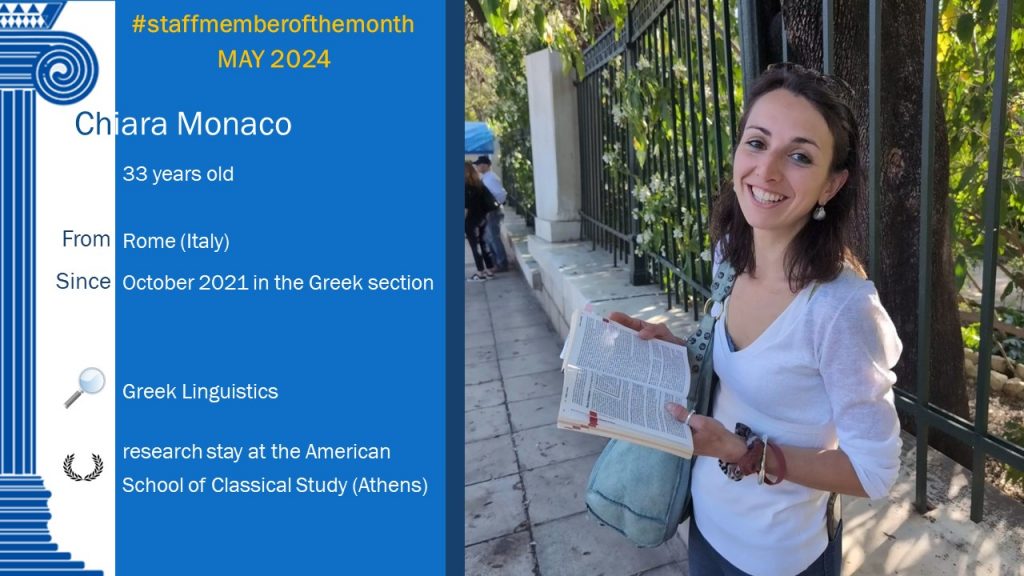
Medewerker van de maand (mei 2024): Chiara Monaco

The staff member of the month is Chiara Monaco, who joined the Linguistics Department of UGent in 2021 with an FWO junior postdoctoral fellowship. Yasmine had a virtual chat with Chiara and asked her all about Athens, where she is currently spending two months as a fellow of the Gennadius Library at the American School of Classical Study.

Hi Chiara! Or, as you’re currently in Athens, καλημέρα! Can you tell us what you are doing there?

Apart from eating, sunbathing and drinking ouzo, I am a fellow of the Gennadius Library at the American School of Classical Study. I am working at the Gennadius Library, which is extremely well-equipped with modern Greek sources, especially in relation to the Greek language question, which is the focus of my research. The founder of the library was quite crazy about languages and language-related issues, so he built up a huge library with all sorts of treasures for people interested in the history of the Greek language, and not only! The library is also beautifully situated on the slopes of Mount Lycabettus, which makes a visit all the more worthwhile.

I am working at the Gennadius Library, which is extremely well-equipped with modern Greek sources, especially in relation to the Greek language question, which is the focus of my research.

Congratulations! It is an incredible opportunity – and definitely something that make your colleagues jealous… How is your ordinary day in Athens? Do you happen to have any local tips?

My ordinary day is actually quite extraordinary, as I have the opportunity to walk around Athens every morning to get to the library (sometimes with some deviations), passing by the main attractions and stopping at a café along the way. Our Greek colleagues have done a great job of passing on their knowledge of museums, tavernas and cafes, and I am happy to share this very important piece of knowledge with anyone planning a trip or research stay in Athens (both highly recommended!). I guarantee the quality!

Looking forward to hearing more once you’ll be back! Just before leaving, you took part in the “Bloemlezing van Aristophanes’ Vrouwenparlement”, an event organized by members of the Greek Section on March 20. I heard it was a great success! What was your role in it?

I had the pleasure of teaching students about Aristophanes and political satire in a workshop organised with our colleague Eleonora Cattafi. We tried to explain the political relevance of ancient comedy with references and comparisons to modern political satire (and a good dose of memes), all the while wearing very fancy Dali-style moustaches, which gave our look an interesting kick. It was a very nice and enriching experience, firstly because it gave us a different perspective on our studies, and also to promote the study of ancient languages among young students. Evelien Bracke and Katrien Vanacker do a great job in organising these events, which, however, require a lot of energy and time, so I think it should be a more collective effort, even more so to enjoy the collective reward of seeing more students in our department!

We tried to explain the political relevance of ancient comedy with references and comparisons to modern political satire (and a good dose of memes), all the while wearing very fancy Dali-style moustaches, which gave our look an interesting kick.

Most of the time, though, you are not wearing a fake moustache to debate about gender issues, but you are sitting at your desk with a pile of books by your side. You joined the Linguistics Department of Ghent University with an FWO postdoctoral fellowship a few years ago. What is your project about? And what do you find to be the most challenging and rewarding in your research?

My project falls within the framework of the Greek language debate about what kind of language should be used for writing and then as a national language. The timeframe is quite broad, as the debate runs through the history of the Greek language, at least from the Hellenistic period to modern times. While for my PhD I focused on the Hellenistic and Imperial periods, for my FWO I jumped a few years forward to study an influential early nineteenth-century theory, the so-called Aeolodoric theory, which defended the use of Modern Greek in writing by seeing it as a mixture of ancient Aeolian and Doric dialects. It is very interesting to note that this theory is based on linguistic theories that were formulated in the Hellenistic period and reused at different stages of the Greek language and were still very much in vogue at the beginning of the 19th century. This gives us an idea of the continuity of linguistic approaches and ideologies from antiquity to modern times. Quite an interesting subject for a classicist interested in modernity, especially as the language question is still a hot topic in Greece today! Despite the many challenges, dealing with such a long timeline carries the risk of applying a modern perspective to ancient sources and vice versa. This is one of the trickiest parts, but it also brings the best reward: the chance to follow the latest episodes!

From Rome to Ghent, passing through Cambridge and with a stop in Athens… What’s next?

I wish I could tell you now, but at the moment I only know that I have a number of applications to send in. In the meantime, I will continue to enjoy Ghent, my friends, my colleagues and the university environment, which is very stimulating. And next year I will probably take the opportunity for another research stay somewhere else!

Thank you very much, Chiara! And enjoy a Greek iced coffee for us as well!

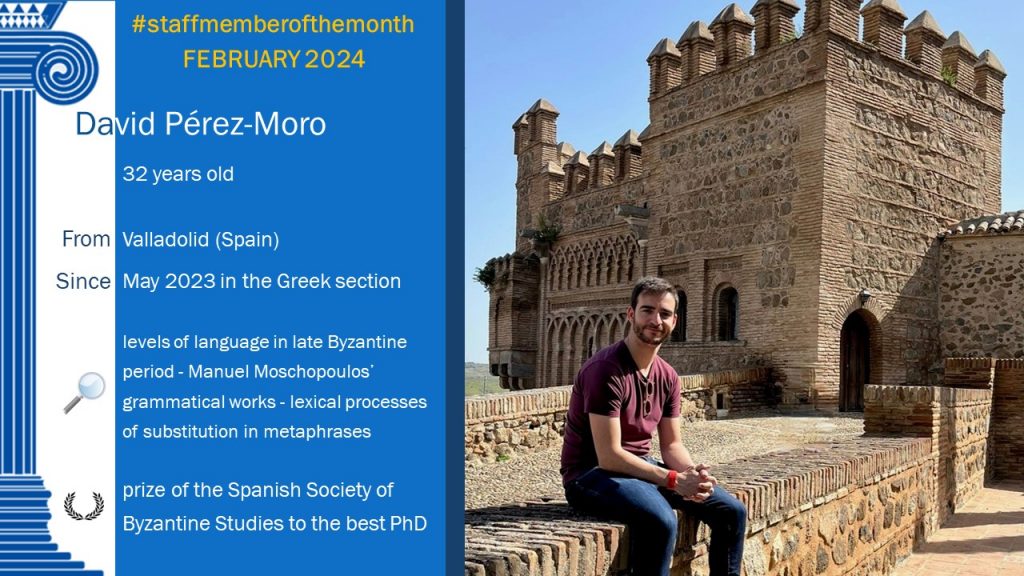
Medewerker van de maand (februari 2024): David Pérez-Moro

The “medewerker van de maand” of February 2024 is David Pérez-Moro, from Spain. David has been part of the Greek Department at UGent since May 2023 and works as a postdoctoral researcher within the ERC project MELA (The Meaning of Language). Michele Didoli has caught up with him to ask him for a review of his (almost) first year in Belgium.

Hi David! After hearing you speak in the kitchen, we are curious to know which Italian region you come from…

Hahaha, I appreciate the compliment, but I am not Italian. I come from Valladolid, a Spanish city in the northwest, in the region of Castile and León. My adventure with the Italian language is a bit long, but I will make a brief summary for you. I studied Italian during my first year of university; later, I lived in Italy for about a year and half; and, last but not least, my family-in-law comes from Veneto, Italy.

Well, then, congratulations on such an excellent Italian! Now we are even more curious to get to know you! Describe yourself with five adjectives – in Italian, Spanish, Dutch or English… whatever you prefer, as you speak many languages!

Well, I could describe myself better with adjectives in Spanish, but I will try to find their English equivalents to make them more understandable to everybody.

I consider myself a (1) precise person. I like doing my work well or accomplishing what has been proposed, even if it requires spending more time on it or helping others to do it. Moreover, in my opinion, it is important to be a (2) tidy person to bring out the best in ourselves and to avoid losing our goals in our personal chaos. On the other hand, I have learned to be an (3) adaptable person, as this helps me to navigate diverse situations with different people without any problem. It is true that, at the beginning, I can be (4) shy, especially because speaking in a language other than your native one requires an extra degree of effort. As for the 5th adjective, I prefer to leave it in blank, so that readers can fill this void according to how deep they know me!

I strongly believe that experiences in other countries contribute to our personal and professional growth; for this reason, I have chosen to spend time in Bologna, Rome, and now Ghent.

Tell us about your studies and experiences abroad that you had before coming here to UGent as a postdoctoral researcher.

I completed my Bachelor in Classical Studies (Latin and Ancient Greek) at the University of Valladolid. This program focuses primarily on the study of Latin and Greek language and literature, and on the methodology for translating Latin and Greek texts into Spanish. Although the main focus was on the Classical period, some professors took the opportunity to introduce us to the postclassical authors, leading me to discover Byzantine Studies, which became the topic of my Bachelor’s thesis.

After these four years – in Spain, Bachelors generally last four years –, I obtained two Masters from the same university, in Pedagogy of classical languages and in Post-Classical languages and literatures. In the latter, I specialised in Medieval and Byzantine literature and linguistics.

Both my Bachelor and my Masters have influenced my decision to do a PhD at the University of Valladolid with prof. Juan Signes-Codoñer. I chose to explore the rewriting process of Homer’s Iliad during the Byzantine period, specifically from a linguistic perspective.

As for my experiences abroad, I spent the third year of my Bachelor at the University of Bologna (Italy) to enhance my knowledge of Ancient Greek – and of Italian, too –. Some years later, during my PhD, my supervisor and I opted for a six-months stay at Sapienza University of Rome. There, I had direct access to manuscripts and bibliographical resources I needed for my project. I strongly believe that experiences in other countries contribute to our personal and professional growth; for this reason, I have chosen to spend time in Bologna, Rome, and now Ghent.

From Spain to Gent on the trail of medieval Greek, then! Tell us more about your research here at UGent within the ERC project MELA (The MEaning of the LAnguage) supervised by Prof. Andrea M. Cuomo.

¡Claro! I am part of the ERC project MELA, led by Prof. Andrea M. Cuomo, with you and with six other colleagues: Katharina Preindl (Project Coordinator), Dr. Valentina Barrile, Dr. Maria Rosa de Luca, Dr. Theofanis Tsiampokalos and Dr. Grigory Vorobyev.

As member of a project, each of us has a specific role, but we collaborate towards a common goal: the study of Byzantine textbooks and the teaching of high-register Medieval Greek. My research, in particular, focuses on Manuel Moschopoulos’ works: his Schedography, his Ἐπιτομὴ Νέα Γραμματικῆς, his Metaphrasis and his scholia on Homer’s Iliad and other minor works. I had previously worked with this author during my PhD, specifically with the aforementioned metaphrasis and his scholia. Now, I am ready to delve deeper into his works.

The primary objective of my research is twofold: firstly, comprehending how Moschopoulos taught Ancient Greek and determining the rules of the high–register Greek learned at medieval schools; secondly, creating a database in which Moschopoulos’ works, manuscripts, language, or metalinguistic terminology are accessible to scholars.

We heard that you gave some lectures in the ‘Ancient Greek Linguistics I’ course. How did they go? Have you had any teaching experience in Spain during your PhD? Did you find any differences between the two teaching methods?

I took part in “Ancient Greek Linguistics I” during the first semester of this academic year 2023/24, and it was an enriching experience! My lessons were devoted to the evolution of the Homeric poems beyond the Classical period. In particular, I focused on the Byzantine instruments, as metaphrases and lexicographical sources, that constituted the way students approached and learnt Homer’s literary production for centuries. I highly appreciated the students’ active participation in the lessons!

Teaching was not an entirely new experience for me, though. In Spain, I have taught at various levels. For two years, I worked in a high school, teaching courses such as Latin, Ancient Greek or Classical Culture. Moreover, I assumed the role equivalent to a lecturer in Spain for “Ancient Greek Linguistics”, a course in the last year of the Bachelor in Classical Studies. Fun fact, even if they share the same name, the program I taught in Spain was significantly different that here at UGent. I had teaching experiences also during my four-year PhD, as in Spain, PhD students with funding can teach up to 60 hours per year. At the same time, I collaborated as a teacher of Ancient Greek with the Faculty of Theology of Northern Spain.

The teaching methodology I employed in Spain and at UGent is quite similar and it focuses on a theoretical-practical approach. However, if I were to highlight some differences in teaching methodologies, I would mention the “mid-term exams”, which I find very beneficial for students and professors. I look forward to learning from the various approaches used at this university.

The primary objective of my research is twofold: firstly, comprehending how Moschopoulos taught Ancient Greek and determining the rules of the high–register Greek learned at medieval schools; secondly, creating a database in which Moschopoulos’ works, manuscripts, language, or metalinguistic terminology are accessible to scholars.

Let’s close by breaking some stereotypes. Spain: hot, sun, playa, sangría. Belgium: chill, rain, Blaarmeersen, beer. Did you feel such a big leap coming here to Gent, or is it just stereotypes? What makes you feel ‘at home’ here in Gent, despite the distance from Spain?

Haha, I love stereotypes because every time I hear them, I realise they are not true. Well, as mentioned, I come from Valladolid, a Spanish city in the northwest. The weather in summer is really hot (30º-35º), but during the rest of the year is cold – and it can even go down to -6º, in winter! – and there can also be foggy days. The nearest beach is along a river… so hot, sun and playa do not represent my city at all. About the last one, I can confess that I do not like sangría: I undoubtedly prefer a cold blond beer. In my personal experience, there are for sure some differences between Spain and Belgium, but the leap is not as big as the stereotypes make us believe, and it is very easy for me to adapt quickly to a new environment.

Since I have arrived here, I have perceived several things in Gent that make me feel at home. Let’s consider human and professional interactions, within MELA project, in my office and in the whole department. My colleagues are very approachable, and I feel at ease. The nostalgia for Spanish language is sometimes mitigated by the presence of other Spanish speakers in our department, such as Dr. Julián Bértola, and by the Spanish tourists in the city center.

Moreover, I have already established new habits here: I live near the remains of Charles the Fifth’s castle, and, on sunny days, I love visiting the park close to them to read a book. And my weekend cannot start without a pizza on Friday evening at Neapolis!

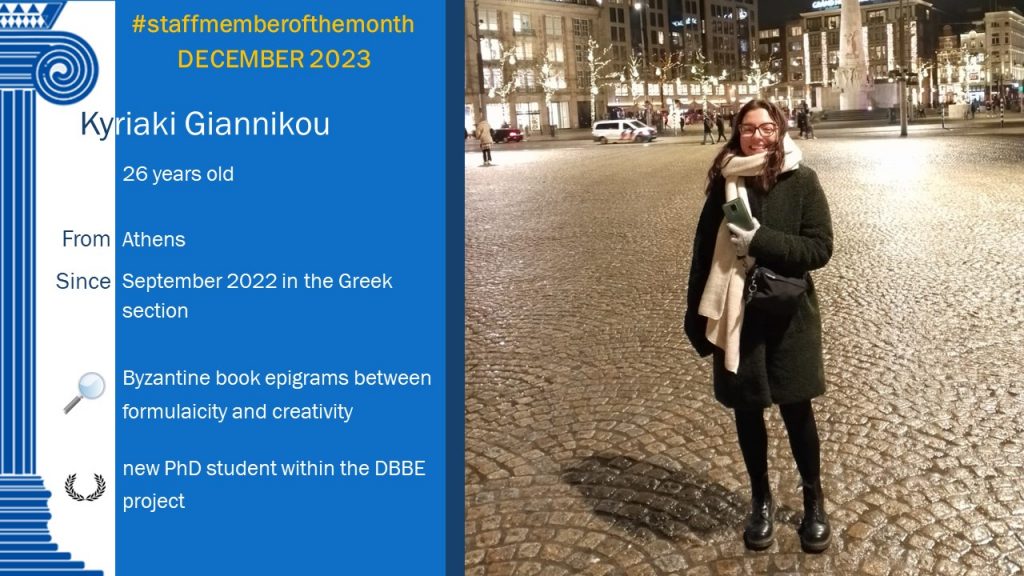
Medewerker van de maand (december 2023): Kyriaki Giannikou

The staff member of this month is Kyriaki Giannikou, who recently started her PhD within the framework of the Database of Byzantine Book Epigrams project. Eleonora Cattafi spoke with her about her past and present experiences in Ghent… and some future wishes.

Dear Kyriaki, you have just started your PhD in our Greek section, but you are definitely not a new face around the corridors of the Blandijn! In fact, you came to Ghent as an Erasmus student for the first time: what brought you to Ghent then and what do you remember from that experience? And why have you decided to come back as a scientific employee?

Choosing Ghent as an Erasmus destination in 2019 was a recommendation from one of my professors, and it turned out to be a transformative experience. The academic and social aspects were enriching, and the city itself felt like a welcoming home. Later, after completing my master’s at Leiden University, I seized an opportunity to work as a Research Assistant at Ghent University, in the EVWRIT project. This served as a valuable testing ground, allowing me to explore whether academia was my desired path. The positive working environment solidified my decision to continue as a doctoral student.

You are doing your PhD research within the new DBBE project “Interconnected texts”, which brings together Greek manuscripts, linguistics, and even artificial intelligence. This sounds very exciting! Could you tell us a bit more about your role in the project and the topic of your doctoral investigation?

Certainly! My research revolves around Byzantine book epigrams, intriguing paratexts nestled within manuscript margins. These epigrams intertwine poetic expression with practical details, unveiling insights into manuscript patrons and the identities of the scribes. Despite their formulaic nature, they also exhibit nuanced linguistic variations; these aspects remain unexplored in current research. Acting as a bridge between linguistic research on everyday speech formulas and those in oral poetry, my work addresses the challenge of identifying linguistic patterns within these short, transient epigrams – all within the intricate constraints of written Byzantine Greek.

Acting as a bridge between linguistic research on everyday speech formulas and those in oral poetry, my work addresses the challenge of identifying linguistic patterns within these short, transient epigrams.

From Greece to Belgium, that’s quite a cultural leap! What do you like the most about your daily life in Ghent? Is there anything you would recommend to future international (or Greek) colleagues to feel at home here?

Despite some cultural differences, Ghent has become a second home for me. What I appreciate most about daily life here, coming from the hustle and bustle of Athens, is the serenity of not living in a capital; it might sound minor, but I’ve noticed a significant change since that transition. To future colleagues, I would recommend fully embracing the opportunity to experience a different culture. Diversity enriches the experience, so I encourage them not to limit their social interactions to those within their own cultural circle. In simple terms, let’s stop complaining about the lack of sun and broodjes for lunch!

Every researcher has an artistic side to complement for their scientific activity, so I am sure you have one too! What do you do in order to relax from work?

Outside of academia, I find solace in crafty activities. Knitting, crocheting, and embroidering are not just hobbies but therapeutic outlets for me; yes, it might make me sound like a 75-year-old lady, but I embrace it! The tactile engagement is a perfect counterbalance to the cerebral demands of research! Moreover, I’ve grown to be a proud plant-mum, creating a calming atmosphere to return to after work.

Knitting, crocheting, and embroidering are not just hobbies but therapeutic outlets for me; yes, it might make me sound like a 75-year-old lady, but I embrace it!

Final question. Since New Year is approaching, do you have any special wishes for 2024 or something you look forward in your academic or personal life?

Looking ahead to 2024, I, of course, wish for breakthroughs in my research, contributing to the broader academic discourse. On a personal note, I wish for personal growth and more opportunities to immerse myself in the cultural richness of Belgium. Here’s to a year filled with exploration, achievements, and enriching experiences!

Cheers to that, Kyriaki! And best of luck with your PhD!

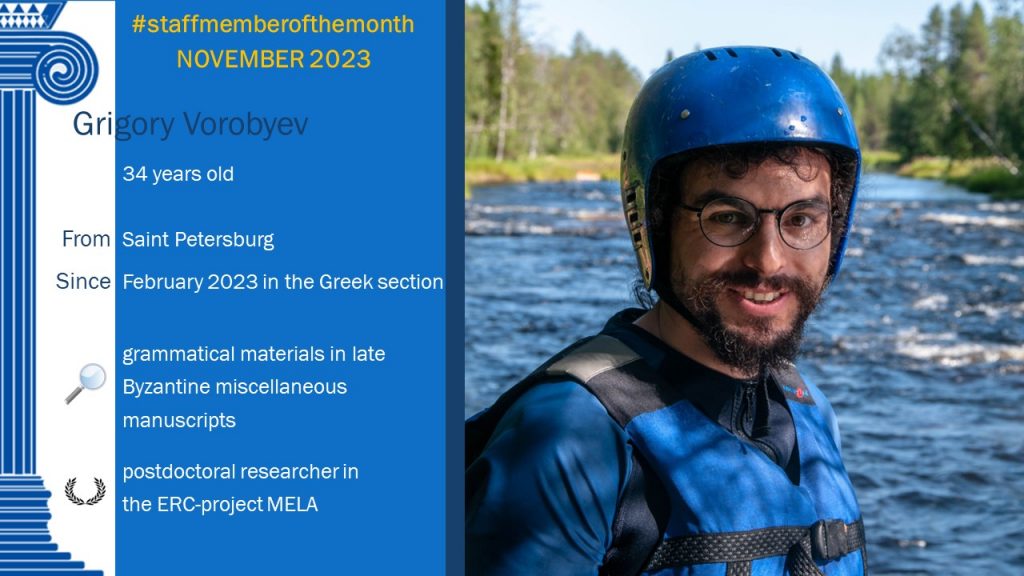
Medewerker van de maand (november 2023): Grigory Vorobyev

Grigory Vorobyev is one of the first members of the MELA project, which started last year. We gave him some time to settle in and look around, and now Serena Causo is very pleased to ask him some questions as our medewerker van de maand!

Hi Grigory! Let’s break the ice with some academic questions: what is your work scope within the project?

Hi Serena! The pleasure is all mine! In MELA, I am responsible for the most down-to-earth part of the job, that is to say paleographic and codicological analysis of manuscripts. Rummaging among old books might sound boring, but I find it the most fascinating activity of all! Indeed, such humble details as a manuscript’s handwriting, watermarks or even wormholes shed light on the history of the texts transmitted in it. Thanks to such information, my colleagues who draw linguistic evidence from Byzantine texts can interpret their data in a more precise way. I immensely enjoy my role as MELA’s paleographer in charge!

It is exciting to be a member of a growing team, to share interests and ideas with your team members, all while building new friendships. How are you getting along with your colleagues within the project and the department? We hope that you had a warm welcome at the Blandijn!

More than that, I am feeling at home! One aspect I would like to highlight is the sense of freedom, and I am not (only) speaking of free coffee. I am deeply grateful to the people who made this feeling possible. Besides, when I just arrived, I was impressed by the chronological span covered by the Hellenists here, and I have to say – this is not an attempt at flattery! – that sharing the office with papyrologists has a strengthening, reassuring effect: I am doing stuff in many ways similar to what you guys are doing for the earlier period, so I feel I am stepping on firm ground! This diachronic dimension of the office space is something I appreciate a lot, just as much as the great help I got, synchronically, from several colleagues when I was looking for a flat and moving! 🙂 As for everyday life at Blandijn, sure enough, I am not the first interviewee to tell you how enjoyable the multilingual atmosphere in the project team and in the department is. This constant code-switching is a healthy habit! Of course, in whatever language you are chatting with a colleague, it is always fun to discover they share your non-academic interests, like early music or water sports.

As for everyday life at Blandijn, sure enough, I am not the first interviewee to tell you how enjoyable the multilingual atmosphere in the project team and in the department is. This constant code-switching is a healthy habit!

We hear that you are a wanderer, both for your interesting academic journey but also because you like to wandel (“walk”) in nature. Tell us more about it!

Indeed, I adore traveling in the wilderness, be it on water or in the woods. When you go kayaking or trekking, the huge advantage is that, in contrast to a conventional vacation, you cannot but leave your laptop at home. The study of manuscripts is a continuous voyage, too: doing codicology is impossible without consulting the originals, and they are kept in libraries all over the world. As for my academic journey, I did my BA and MA in Saint Petersburg, the city where I was born, but that period also included a fantastic exchange semester in Florence (that’s where I fell for paleography) and a short research stay in the Hellenic Institute in Venice. My double passion, for the Italian Renaissance and for Greek manuscripts, brought me then to Münster and Rome. I defended two doctoral theses on different topics, in Rome and in Saint Petersburg, and started working in the latter place. Apart from teaching, I was involved in several projects in the fields of Neo-Latin philology and Greek paleography. It was rewarding to work with manuscripts there, for they are quite numerous and to a great extent unstudied. Still, something went wrong outside academia. Already in the 2000s I was aware that terrible things were going on in my country, the feeling of helplessness and shame has been increasing ever since, and yet, even after the catastrophic invasions in 2008 and 2014, despite the steady growth of repressions and censorship, I hoped against hope that the regime would change soon. Well, that optimism turned out to be naïve. In late February 2022, I grabbed my backpack and got on board one of the crowded airplanes heading to Istanbul. As numerous Russian scholars who spoke up against the war and for whom it was unbearable to stay in their country any longer, I fled. I was lucky enough to have that possibility (indeed, so many people who want to leave are unable to), and I was even luckier to quickly get two short-term research positions, first at the University of Innsbruck, in the Noscemus project, and then at the Free University of Berlin, in the Aristoteles-Archiv. In both places I had the opportunity to work on topics very close to those I had been dealing with before. In 2023, I became a member of the MELA team, and I cannot express how happy I am to be part of it now. Ghent University is more than a safe haven for me: as I said, I feel at home.

In late February 2022, I grabbed my backpack and got on board one of the crowded airplanes heading to Istanbul. As numerous Russian scholars who spoke up against the war and for whom it was unbearable to stay in their country any longer, I fled. I was lucky enough to have that possibility (indeed, so many people who want to leave are unable to).

The initial period in a new country is the moment when one starts to settle in and build his own new habits. Have you already established some favorite rituals – maybe a place to go, a bite to eat, a person to hang out with – in Ghent?

In Ghent it is easy, for this city is so welcoming and, if I may use this word, cozy! It boasts a marvelous selection of cafés, but almost directly upon my arrival I discovered an alternative to having a piece of cake in one of those: you can just take a broodpudding at Bloch and consume it meditatively in the stillness of Blandijn’s Japanese hortus conclusus. As for my other new rituals, I found a regular jam session to participate in and I joined a choir. Besides, I am enthusiastic about the fact that Ghent has so much water. I grew up at the riverside, so the mere fact of crossing two bridges on my way to the university is a gratifying routine.

Last question for a travelling academic: what is the one book that you must always bring with you when you move to a new country?L

Well, this might sound strange from a person who works with manuscripts, but the nomadic life I have got used to over the past decade has taught me that living close to a good library is more important than possessing books. Hence, to my mind, the only indispensable book-like object to carry with you whenever you move to a new country is your head!

Thanks for taking the time to answer our questions, Grigory! We are glad to have you with us and we wish you the best of luck with your work!

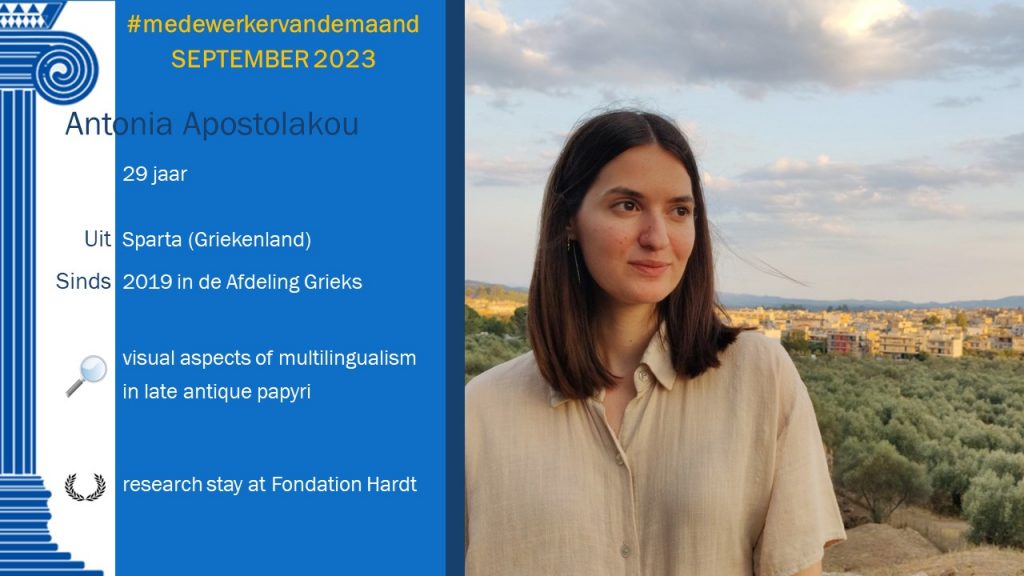
Medewerker van de maand (september 2023): Antonia Apostolakou

The staff member of this month is Antonia Apostolakou, who recently went on a research stay to Switzerland and is now putting the finishing touches to her PhD dissertation.

Hi Antonia! In the Blandijn, you are quite famous to be the girl coming from one of the most evocative places in Greece: Sparta! Could you tell us more about your homeland and the adventurous journey that brought you to Ghent?

Hello! That’s true. Although people usually have a surprised reaction when I introduce myself at conferences, it does make for a good icebreaker, I have to admit. Sparta is a charming small city in the Peloponnese, surrounded by mountains, full of olive and orange groves, with locals that may exceed 300 but still come in short numbers. Apart from the natural beauty of the area and its apparent historical reputation, Sparta has been and is still being associated with a military lifestyle, extreme discipline, and toughness. This image has made its way to pop culture (for example in films or video games – there have been some nice discussions by classical scholars on this subject over the last couple of decades) and has been worshipped by notorious dictators and like-minded groups to this day. I therefore tend to be cautious when it comes to boasting about my hometown. The occasional homesickness and the excitement of colleagues have definitely made me focus on the bright side, though, so I will hopefully not disappoint any more enthusiastic classicists.
Now that I have already set out the proper ground for treason, I will continue by saying that my academic journey started when I moved to Athens. There, I studied ancient, Byzantine, and modern Greek philology, and had a lovely time that generated some of the tips I’ve been sharing with many of you before your Athens visits. I specialized in linguistics, and my fascination for the field led me to the Netherlands, where I completed my master’s, with a focus on intercultural and multilingual communication. After graduating, I came across an announcement for a PhD position at Ghent University and the EVWRIT ERC project. It felt like an ideal opportunity for me, as it combined all different aspects of my previous education and training: classical and Byzantine studies, but also multilingualism and language contact. And, better yet, the position offered a new challenge: papyrology! I applied, flew to Belgium for the interview, and the rest is history. A fun fact is that I had visited the city one year earlier with a friend and, as I liked it a lot, had said: “I could live here.” I am still enjoying my time in Ghent, so it turns out I was right.

My tip to new international colleagues, which applies to differences beyond eating habits and weather conditions, is to keep an open mind and try to find the beauty in everything unfamiliar, rather than get trapped in seeking what they had back home.

Replacing spanakopita for boterhammetjes must not have been easy! After a few years living here, I believe you developed some strategies to master the art of the broodje and to adjust to the northern weather. Do you have any tips to share for our new international colleagues?

Just as I was complimenting Belgium, you needed to bring up the food… Just kidding! Surprising as it may seem, I think my Greek culinary skills got stronger over the last years – sharing food with friends is always a pleasant experience. Quite unexpectedly, though not for those who are aware of the composition of the Greek section, I also became more familiar with Italian cuisine from different regions (shoutout to all the friends who have kindly invited me over for dinner) and gained a new appreciation for it. I do, however, occasionally enjoy the late-night frietjes or take my visitors to local restaurants to try stoverij, and I appreciate the many veggie options in Ghent (Did you know it’s one of Europe’s veggie capitals?). I’m also a big fan of Belgian desserts, especially a warm Liège waffle or a good mattentaart. I am afraid the lunch broodje and I still have some way to go. Belgian weather is certainly different than what I was used to growing up, but there is a number of fun and relaxing things I like to do when it’s rainy: going to the cinema, visiting exhibitions in Ghent or Brussels, watching shows while enjoying a cup of hot chocolate with friends or just curling up by the window with a good book. And once the sun shines in Belgium, everyone is excited and goes out for ice cream or a glass of cold beer by the water. My tip to new international colleagues, which applies to differences beyond eating habits and weather conditions, is to keep an open mind and try to find the beauty in everything unfamiliar, rather than get trapped in seeking what they had back home.

As you mentioned before, you joined the Linguistics Department of Ghent University to start your PhD within the ERC project EVWRIT. What is your research project about?

Right! It is one of the linguistics projects of the ERC, that nevertheless incorporates many paleographic observations. Simply put, it’s an investigation of papyri from the fourth to the eighth centuries CE, where more than one language and/or script are used. I could say that the project was inspired by my own experiences to some extent, as I have grown up in a bilingual environment (on my mother’s side), and have witnessed intriguing switches between the Greek and English languages by my relatives – or a mix of Greek and Latin characters in some of my grandma’s amusing notes and gift tags. In papyri too, we find certain choices in language and its writing (for example, writing Greek in Latin script or mixing letters from different alphabets within a single word) that often seem unconventional by modern standards, especially in the context of more formal documents. My project aims at understanding the complex motivations (sociohistorical, textual/practical, cognitive, etc.) behind this variation, and evaluating their importance in enhancing or creating meaning. To do this, I use theoretical concepts and methods from historical sociolinguistics and socio-semiotics, language and script contact studies, comparative paleography, and more, depending on each case study.

I could say that the project was inspired by my own experiences to some extent, as I have grown up in a bilingual environment (on my mother’s side), and have witnessed intriguing switches between the Greek and English languages by my relatives – or a mix of Greek and Latin characters in some of my grandma’s amusing notes and gift tags.

Sounds fascinating! Our work allows us to travel all around the world, and I have heard that you have been able to enjoy a couple of great experiences abroad in the last year. We want to know more! (Where were they? And on which purpose did you go there?)

I was indeed lucky enough to obtain a couple of scholarships and visit some beautiful places over the last year. The first highlight was without doubt the Summer Institute in Papyrology. After its postponement due to the pandemic, I managed to travel to Cincinnati for the summer institute last summer. During this intensive training, I improved my knowledge on papyrology and the preparation of papyrus editions, while working on original papyri from the collection of the University of Michigan, under the guidance of distinguished instructors. It was also a very fun month of making new friends, watching the fireworks on the 4th of July, and racing on chairs with wheels at the dorm’s corridor. I returned to Europe just on time for the 30th International Congress of Papyrology in Paris, which was completed with a memorable celebration of my birthday on the waters of the Seine. My second longer stay was at the Hardt Foundation in Switzerland in late spring. I was happy to work on my project in a beautiful library and interact with classical scholars of different ages and backgrounds on the daily, while enjoying the generous services provided by the kind staff of the foundation. Once books and laptop screens were closed for the day, I went on small excursions with lovely colleagues, like visiting the Bodmer Foundation, exploring Geneva by night or even traveling to a suburb where Kieslowski’s “Red” was filmed.
While all these experiences may sound wonderful (and they absolutely were), it’s important to remember that doing a PhD is not “all play and no work”, in more senses than one. It’s a personal journey and a challenging experience with many ups and downs, and I feel fortunate to have been able to share both my achievements and struggles with other PhD candidates in Ghent since the beginning of my project.

One final question: as we were children, September used to be the start of a new exciting school year. Sure, we now have moved to a bigger building and switched apple juice for coffee, and oral tests to conference papers, but September still feels like our yearly turning point. With the beginning of the new academic year, what are your good resolutions?

I think that highly specific resolutions like the ones people come up with on New Year’s Eve put unnecessary pressure on many of us, so I tend to avoid them and think of a very general and easy one instead, just for the fun of it. My 2023 resolution was to let myself be surprised, and I can tell you it has been a success so far! I nonetheless have a few humble plans for the new academic year and the near future: submitting my dissertation, completing some editions, and evaluating the options ahead. I would also like to do some more carefree traveling and maybe return to taking a language course after a short break. And let’s see if that one friend and colleague finally convinces me to join her at the gym – that would be the ultimate surprise for everyone!

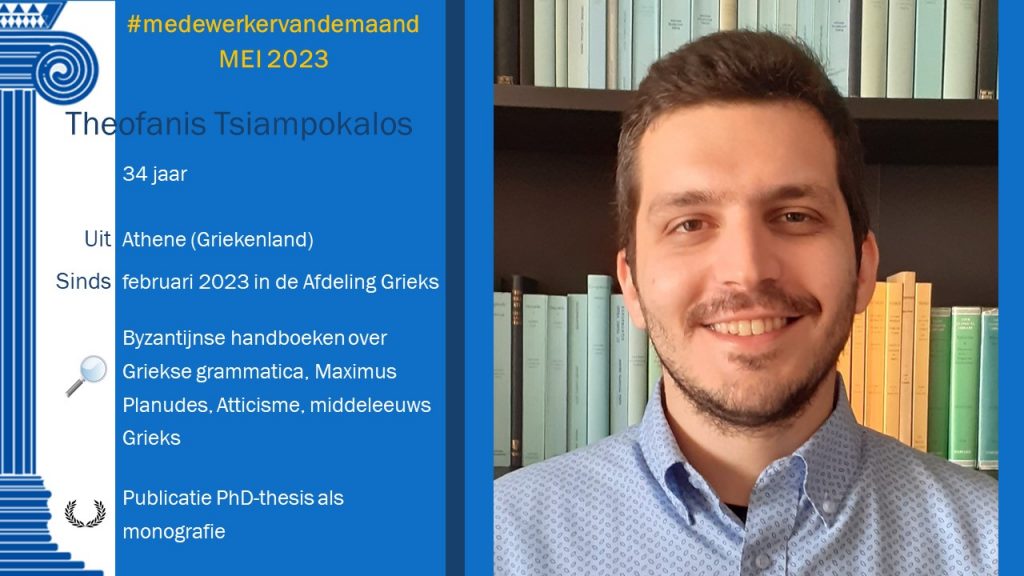
Medewerker van de maand (mei 2023): Theofanis Tsiampokalos

Many new faces in our Greek Section these last couple of months: one of them is Theofanis Tsiampokalos, who recently started working as a postdoctoral researcher on the ERC-project “The meaning of language. A digital grammar of the Greek taught at schools in Late Constantinople” (MELA). Anne-Sophie Rouckhout caught up with him to ask about his first experiences as a new member of the Greek pack at Ghent University.

Hi Fanis! You started working at UGent a few months ago, on a brand new ERC-project called MELA. Can you tell us something about your research context and your own role in it?

Hi! Yes, I joined the Linguistics department at the Ghent University in February and I am really excited to be here, in this very beautiful city, and be part of this wonderful community. MELA, the project I am involved in, is – as you already said – a brand new ERC-project of Andrea Cuomo, hosted at the University of Ghent. The project brings surviving grammatical textbooks of the late Byzantine period to the fore. Throughout the whole period from the early sixth to the mid-fifteenth centuries CE, knowledge of a high-register variety of Greek, one which was modeled on a selection of ancient canonical authors and the church fathers and, therefore, differed from the contemporary vernacular, would mark in the Eastern Roman Empire a young adult for a promising career in the administration of the state or church, pretty much in the same way as in later times knowledge of Latin would mark someone for a post within the British Empire. MELA’s main aim is to achieve a deeper understanding of this language by means of producing a digital grammar of the Greek taught at schools in Late Constantinople, from where several textbooks survive that have not received so far the attention they deserve.
Within this broad context, my work focuses on a number of grammatical textbooks written by Maximus Planudes, a leading scholar of the late thirteenth/early fourteenth century. I try to shed more light to the sophistication that these textbooks show in particular, especially in terms of what we nowadays call “information management”.

Our Greek section hosts many international researchers, but not many of them are actually … Greek! How has the Ghent life been treating you?

The truth is that people expect a researcher to be detached from the object of their study, which is obviously not my case. I am joking. It was actually somewhat of a coincidence that I decided to study Greek in the first place – I was showing a similarly great interest in Latin as well as in Ancient History, and I think I would be as happy as I am now, had I chosen any of these subjects instead of Greek. I guess, what fascinates me in these subjects is the potential they show to help us overcome – as Hugh Lloyd-Jones eloquently put it – “the provincialism of those who know only their own period”. In other words, Greek and Latin literature as well as the ancient world in general could serve as a mirror for our contemporary world.
That said, I cannot but admit that the interest that people in Ghent show in both the Greek language and Greece really touches me – I am not talking about the Ancient Greek language and Ancient Greece. The activities organized by the “Griekenlandcentrum” at Ghent University focus on the Early Modern, Modern, or even Contemporary Greece . Last week, for example, I visited a fascinating talk on Greek children’s adoptions to the US and Netherlands during the 50es and 60es. These events attract not only people from the University, but also people who simply live in Ghent and show an interest in Greece, of whom many even learn Modern Greek – and needless to say, they grasp the opportunity to practice their Greek with me. I have been really impressed by their language skills by the way. My resolution for the next years is to master Dutch as well as they have mastered Modern Greek.

I guess, what fascinates me in these subjects is the potential they show to help us overcome – as Hugh Lloyd-Jones eloquently put it – “the provincialism of those who know only their own period”. In other words, Greek and Latin literature as well as the ancient world in general could serve as a mirror for our contemporary world.

If you have to name one weird habit of your Belgian colleagues, what would it be? No worries, we can take it! 😁 Also, for which reason are you most happy to be working here?

I haven’t spotted a particular habit of my Belgian colleagues. Is there something I should be aware of? I am joking. The only funny thing that has happened so far concerns the language. Before moving to Belgium, I was living in Germany, and even before that in Switzerland. But even though German and Dutch have much in common, there are still some “false friends” – my personal favorite is “bellen”; in German, it means “bark”.
The reason I am most happy to be working here is definitely the people. On the one hand, Ghent is a very beautiful city, full of super-friendly people. On the other hand, my colleagues at the University, be it from the MELA project or from the department in general, have proved themselves not only extremely friendly, but also very supportive. They are also very open to exchange and share insights from their own research and are always interested in hearing about my own work and giving me feedback. They have created a very fertile environment here and I am very glad to be part of it.

The reason I am most happy to be working here is definitely the people. On the one hand, Ghent is a very beautiful city, full of super-friendly people. On the other hand, my colleagues at the University, be it from the MELA project or from the department in general, have proved themselves not only extremely friendly, but also very supportive.

Now, let’s be serious again. This year, your PhD thesis was finally published as a monograph – congrats! You must be very proud … and maybe relieved?

Thank you very much! Yes. Soon after my defense in 2018 I started editing my thesis, so that it may be published as a monograph. My book is about Plutarch’s attitude towards rhetoric, an attitude which earlier scholarship had interpreted as rather ambivalent. My approach amounts to the first attempt to see this attitude within the broader context of the traditional conflict between philosophy and rhetoric in antiquity, while paying particular attention to the role that a subject so loaded as rhetoric might play for the construction of a distinct philosophical identity by Plutarch.
The first edition of my book in Modern Greek is about to appear in Athens – the book will be released within the next few weeks –, while a second edition in English is currently in preparation. I am indeed very relieved that this circle is gradually closing, also because the preparation of my thesis for publication had been a side-project for me over the last years. I was fortunate enough to begin my first postdoc in Trier, in Germany, already a month after receiving my PhD. It lasted for three years. This postdoc was on a different topic than my thesis – it was on the reception of presocratic philosophy –, which represented for me a unique opportunity to delve into a new area and, thus, broaden my research profile. But this also meant that the time I could invest in editing my thesis ought to be limited. Nevertheless, I managed to cope with the situation and I am now very happy.

Summer is coming! Will you stay in the Blandijn office or venture out into the world? Any particular plans that classicists might find interesting or inspiring?

I guess, the ideal for summer vacation for every classicist involves a combination of culture, culinary delights and the Mediterranean. In August, I am going to spend some days on Crete. It has been ages since the last time I visited the island. I would like to visit the new Eleutherna museum.

Sounds wonderful – don’t forget to send us pictures! 😉 Thank you for the interview, Fanis, and good luck with your research!

Medewerker van de maand (september 2022): Marta Capano

We’re not only saying goodbye to summer this month, but also to our beloved colleague Marta Capano, who has been working on the ERC project “Everyday Writing in Graeco-Roman and Late Antique Egypt” since January. Anne-Sophie Rouckhout talked with Marta, to ask her about new adventures, fond memories and an exciting event that took place this month…


Hi Marta! You have been part of our section as a scientific collaborator for the EVWRIT project. Can you tell us a little bit about the work you have been doing?

Hello, and thanks for this opportunity! At Gent, I have been working with the EVWRIT research group, which investigates communication in documentary papyri. With Prof. Klaas Bentein, EVWRIT’s PI, I researched pragmatic functions in the language of Greek papyri, and especially on the link between textualization and speech acts, which means that we want to understand how the writer organized what they wished to express or achieve. For instance, it is very interesting seeing how politeness and making a request interact with each other! You can read very fun papyri from the 1st c. CE where subordinates carefully try to make their bosses do things without being disrespectful!

New adventures ahead, because you have been rewarded a fellowship at the Centre for Hellenic Studies of Harvard University. Congratulations! What research will you be working on there?

Thank you so much! It’s going to be a lot of fun! Here at the CHS I’m conducting my own research project on multilingualism in Sicily in the postclassical period. Basically, I study the choice of inscribing bilingual inscriptions (similar texts in different languages on a single stone) and the social implications of this choice. What does it mean if you have a private funerary stone that is bilingual? And what if there is a public monument with two languages? In addition, I investigate phenomena of language contact with Latin and Punic on seemingly monolingual Greek texts. It’s fun to see how sometimes you can have a monolingual Greek inscription with a lot of language contact, while a public bilingual inscription with two texts that are purposefully “pure”, without any form of contact. Also, the Center for Hellenic Studies has welcomed many Gentenaars over the years, and it is a spectacular place to do research. Check it out on the internet!

I study the choice of inscribing bilingual inscriptions and the social implications of this choice. What does it mean if you have a private funerary stone that is bilingual? And what if there is a public monument with two languages?

We also have another reason to congratulate you, because a little bird told us you got married a few weeks ago – at a medieval cloister, no less! What was that like?

Aw, thank you! It was a truly wonderful, sunny, and happy day! We got married in a former convent in Sestri Levante, Italy, with a lot of friends from many parts of the world. A friend of mine actually married us, and it was a fully bilingual wedding! My husband is an American academic, and just won a Fulbright scholarship to conduct his research in Greece, so we had to separate just a few days after the wedding – we’ll see each other again in two months. Our case is not unique in academia, but it still feels very wrong not to be together. Hopefully, our commitment to our careers will pay off.

Did you find some time for holidays this summer, to take a break from both work and the wedding preparations? Have you been able to plan a honeymoon?

Well, I had to spend some of my vacation dealing with the wedding organization, because marrying a foreigner requires extra bureaucracy, so alas I could not go anywhere else but to my hometown in Liguria. However – as my brand-new husband says – there are worse things in life than spending time in an Italian town on the sea. For the honeymoon, we are thinking of the Dutch Caribbean, possibly Bonaire. I suspect neither of us is yet tired of trying to speak Nederlands (quite poorly, by the way).

I love Belgian food (and drinking) culture, the beautiful Belgian architecture, and the very diverse language landscape.
I find it fascinating how dialects change across a very small geographic area.

Which fond memories will you take with you from Ghent? And what Belgian peculiarity/custom/habit will you miss most?

I am very fond of Ghent! I’d never been to Belgium before coming to UGent, and I immediately fell in love with the University and with Flanders. Ghent University is very open to foreigners, and everyone made me feel at home – I hope to return in the future, also because I miss so many friends already! Outside academia, I love Belgian food (and drinking) culture, the beautiful Belgian architecture, and the very diverse language landscape. I find it fascinating how dialects change across a very small geographic area. In Europe, this is something I’ve seen in only in Italy, and it’s a richness to be very proud of. On a personal level, I will always be fond of the lack of ostentation of the Flemish people, and their love for broodjes! I found myself preparing a broodje here in Washington DC. Let me tell you, it is not the same away from Ghent’s canals and summer light.

Thank you, Marta! Good luck with your research project and enjoy your stay at Harvard University! We hope to see you again soon to have a Gents broodje together!