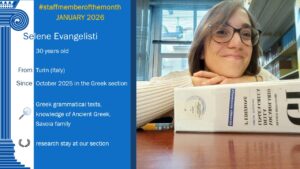
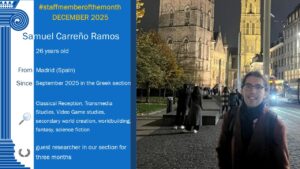
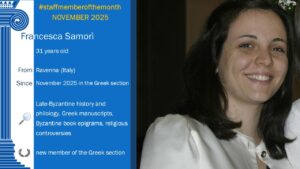
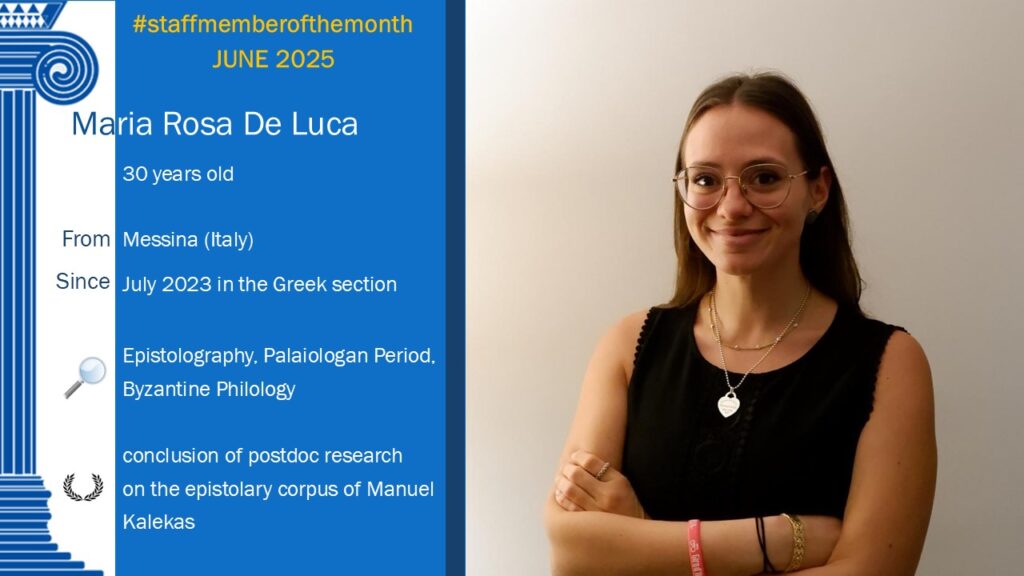
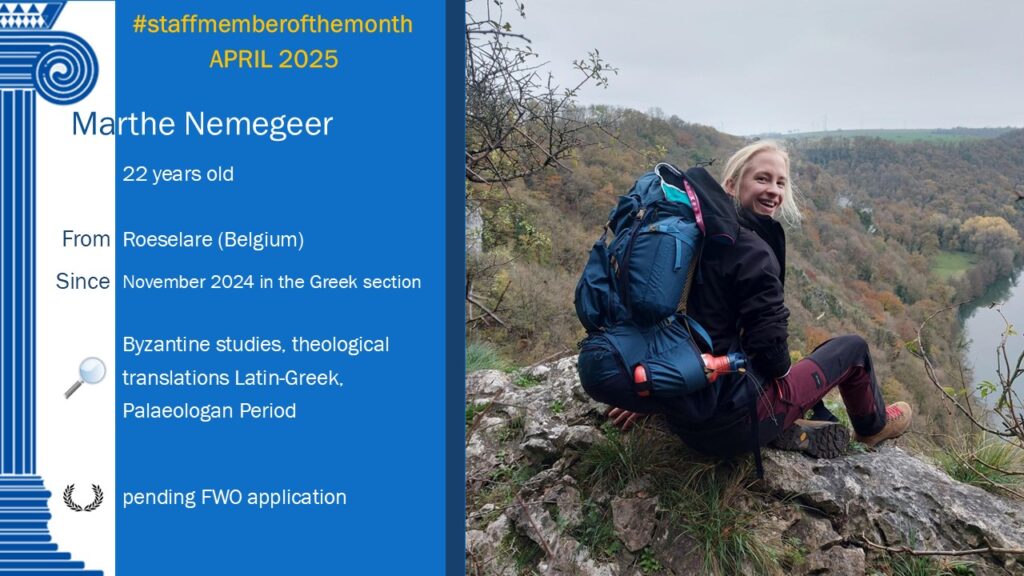
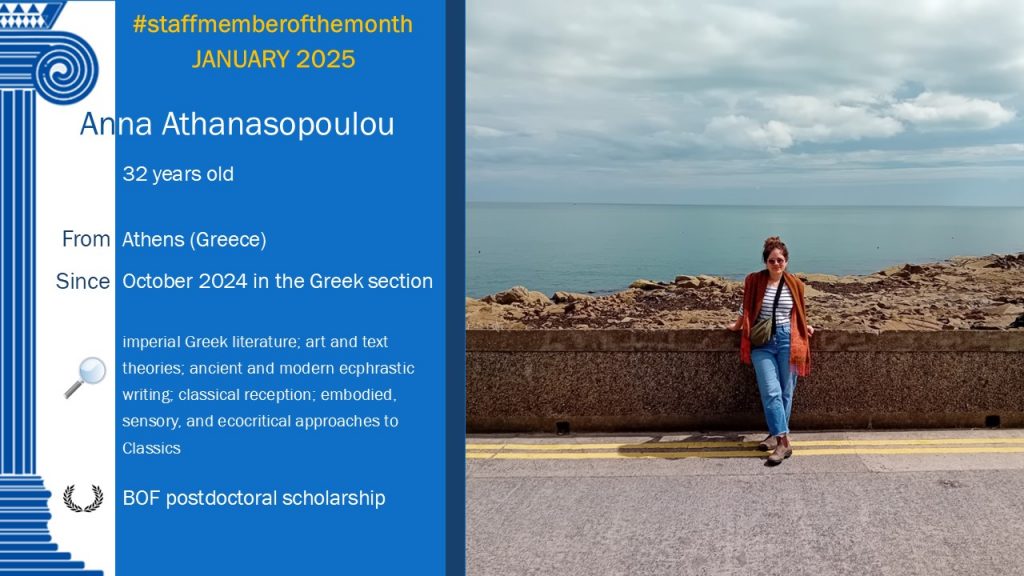
This month’s staff member of the month is Dalia Pratali Maffei, currently surviving, if not thriving, in the final stages of her FWO junior postdoctoral project. Giulia Paoletti spoke with her about her research, her US adventure, and the many places she has called home.

Hi Dalia! You have been here in Gent for almost three years already, so it’s time for you to be employee of the month! Would you like to tell us more about your project here?
Hi Giulia – definitely! My project here is called ‘Sociolinguistic variation in Ancient Greek dialects: mapping the contact between Doric and Koine Greek’. In short, I am trying to understand how Modern Greek as we know it today – derived from the Koine – ended up kicking out all the competition, i.e. all the dialects spoken before it. I focus on Doric and its speakers because it seems to have been the most stubborn and resilient dialect. Some scholars even suggest that it may have survived up to modern times in some mountainous areas of the Peloponnese. Looking at the period when Doric and Koine were in contact, I am interested in how and where speakers continued to use the dialect, and why. At the same time, I study how they mixed it with the Koine, and how they learned what would eventually become the new standard. When a new lingua franca spreads, using your dialect suddenly becomes meaningful: it can signal group identity, as well as ideological and political stance. We have plenty of examples of this today as well – I will let you think of some!
I am trying to understand how Modern Greek as we know it today – derived from the Koine – ended up kicking out all the competition, i.e. all the dialects spoken before it. I focus on Doric and its speakers because it seems to have been the most stubborn and resilient dialect.
If Doric and Koine were people, would their relationship be more like rivals, roommates, or reluctant colleagues?
Great question – and actually a really hard one, and something scholars still fight about. Apologies for the very academic reply, but I think it would depend on the context, place, and time. In some areas, we find fairly stable mixed Doric-Koine varieties. This feels like a “roommate relationship”: you learn to live with each other, compromise, and find a balance. This seem to be the case, for instance, in North-West Greece, and especially in the sanctuary of Delphi, which retained partial administrative autonomy. There, Koine mixed not only with Doric, but also with the dialect of whoever was mentioned in the inscription, as a way of representing and respecting their identity. The reluctant colleague scenario makes me think of places where Doric and Koine were used in inscriptions in completely different contexts, putting some boundaries to have to deal with each other the least, but still having to tolerate the other’s presence. A good example could be Thera (Santorini): under Ptolemaic control, Koine was used for public inscriptions, written by officials, while local dialect was still going strong in private inscriptions, written by private individuals. In the end though, a kind of “rivalry” situation is what prevailed everywhere: Doric and Koine being used side by side across domains (private, public, religious, etc.), with the latter ultimately winning everywhere. It was a quite heated battle indeed – and four centuries long, if not more!
Last spring you did a research stay in Los Angeles, what can you tell us about that experience, beside the weather being amazing? Did you have time to venture outside LA and visit other places in the US?
Well, first of all, yes, the weather was amazing, and I think what struck me the most, as a plant-obsessed person, was the incredible variety and abundance of vegetation, everywhere, even just walking around. I was at UCLA, in the department of Indo-European studies, and I really got to immerse myself in the graduate environment, which is extremely busy but also very stimulating. I met some wonderful people and felt very welcome there. I learned a lot beside accidentally picking up the LA everyday-gym-and-smoothie-in-lululemons-bc-otherwise-you-are-a-noone personality. It was the first time for me on the West Coast, so I did take the opportunity to visit LA (highly recommend the Ghetty, among other things) and venture to SF, Joshua Tree, and the famous Canyons. I am kind of astonished I made it back to Ghent: besides dodging wildfires and ICE, my car got stuck in the Death Vally at 55°C due to overheating, I punctured a tire in the middle of nowhere (…rescued by none other than a missionary), DIY-ed with strangers in the SF hippie neighbourhood. Among other things. But here we are!!
I cannot imagine living somewhere without water canals or streams. It really brings me peace.
Last question! You’ve lived in Venice, Cambridge, and now Ghent, three very different places. Is there something that connects them for you? And what do you think each place has given you, both personally and academically?
Look – colleagues have already teased me for saying this, but I will reiterate: to me, what these places have in common is water. I cannot imagine living somewhere without water canals or streams. It really brings me peace. Historical buildings and tiny walkable pebbled streets probably help too, I’ll admit. I think every place brings out different selves, and I always like to joke that my Italian, Cambridge, and Ghent personalities are all so different – and sometimes hard to reconcile. Now I eat Belgian fries basically once a week; in England – no, wait, yeah, in England I still ate Italian pizza once a week. Whoops. Academically, I think my trajectory also partly reflects how I feel about these places. Venice gave me very strong, solid basics across disciplines and helped me discover my interests. Cambridge taught me new ways of doing academia and trained me to apply them. And Ghent has given me freedom, making me realise I could have fun and experiment with what I love, and build my own path.