Our employee of the Month is Luca Licitra, who joined our section in September 2025.
Nicolò talked to him about his Ghentian experience, his life in Switzerland, and his PhD Project!
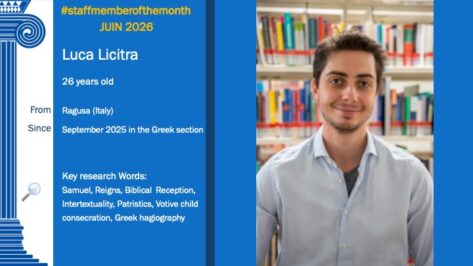
Welcome to the medewerkers’ Hall of Fame, Luca! How does it feel to be here?
Deeply honoured, very flattered, and perhaps even a little light-headed, all at the same time.
The latter may be due to the current weather. Did you get the email about heat regulation?
I did. Well, maybe not literally light-headed. But I am genuinely touched that our good colleagues at the department would be interested in knowing a little more about my experience and research here in Ghent.
You’ve been in Ghent for nine months already. Describe your experience in three words, one per trimester.
If you allow these three words to be somewhat morphologically mixed, I will therefore steal those of my betters and say, with Horace, that Ghent miscuit utile dulci. A great place for living, thinking, and expanding one’s research.
I say, with Horace, that Ghent miscuit utile dulci. A great place for living, thinking, and expanding one’s research.
So cultured. You’ll soon be back to Bern to finish your PhD. You know, I’m always reminded of the Harry Lime line about Switzerland from The Third Man: “500 years of democracy and peace, and what did that produce? The cuckoo clock.” Any thoughts?
Switzerland is also the cradle of some peaks of worldwide cuisine, such as the unique rösti (definitely not a hash brown) and the crowd-beloved Älplermagronen, a complex palate-teaser involving pasta cooked with cream, cheese, potatoes, onions, and, with admirable audacity, apple purée as a garnish. Jokes apart, Switzerland is a place I have called home for some years now, and what I admire most about it is precisely what the joke misses. It is not only a country of order, trains, and administrative letters that somehow always arrive on time. It is also a remarkably plural place, where different languages, traditions, religions, and cultural sensibilities coexist in very close proximity without having to collapse into one another. Coming from Italy, and working in a field where questions of identity and tradition are never very far away, I find this genuinely fascinating.
Hey, Luca, would you say that Belgium’s groovy but Switzerland’s gruvyère?
…
I said, would you say that Belgium… never mind, let’s move on. From a fiscal paradise to the Judaeo-Christian one. Biblical reception! That’s the topic of your research, no? Tell us everything. Be very brief, mind you.
Well, “reception” is one of those words that can mean almost as many things as “paradise” itself.
Or as “Älplermagronen”, I hear.
Sure. Anyway, as I was going to say, the starting point is a wider project launched in Bern in 2023, The Jewish and Christian Samuel, which investigates the reception of the prophet Samuel across Jewish traditions, Hellenistic Jewish and rabbinic, and Christian traditions, both Greek and Latin. Samuel is a fascinating figure because he is important, but not quite omnipresent in the way other biblical figures are. His reception is discreet, but precisely for that reason very revealing. My own part of the project deals with the Greek Christian reception of Samuel. To put it simply, I distinguish between cases where Samuel remains within his own biblical world, and cases where Samuel is transposed into a new literary setting. This transposition can happen in different ways. Sometimes it is very explicit, as in apocryphal or pseudoepigraphic literature, allegorical and typological exegesis, or rhetorical exempla. At other times, it is more discreet, as in cases of narrative mimesis. My research focuses exactly on this transposed form of reception. I look at how certain roles of Samuel gradually crystallised in tradition: Samuel as the vowed child, Samuel as defender of orthodoxy, and Samuel as seer. For each of these roles, I work primarily with bio-hagiographical narratives from early Christianity to the Middle Byzantine period, while also moving into other genres whenever this helps explain how a particular image of Samuel took shape.
Samuel is a fascinating figure because he is important, but not quite omnipresent in the way other biblical figures are.
His reception is discreet, but precisely for that reason very revealing.
And for all of this you had to come to Ghent?
Of course, Ghent has been especially important for me. At the Novel Saints Centre, with Koen De Temmerman, I could think about saints’ lives not simply as repositories of biblical allusions, but as sophisticated narrative texts. At GCLA, with Lieve Van Hoof and Peter Van Nuffelen, I could place these materials more firmly within the wider literary and intellectual culture of Late Antiquity. This combination proved especially valuable for my project, as it allows one to trace many later hagiographical narrative patterns back to the cultural, religious, and political dynamics of Late Antiquity. And sometimes, when one looks at phenomena across such a longue durée, one can even see how a single author redirected the reception of a figure for centuries. For instance, Gregory of Nazianzus…
Easy now, Luca, I’m starting to feel the longue durée of this answer. Let’s save the rest for the defense, shall we?
As you wish. What else do you want to know?
I’ve recently learnt that you are useful in an escape room. How did academia prepare you for that?
You are referring to the first and only escape-room experience I have ever had, thanks to our dear colleagues from the Ancient History department, who are so close to us intellectually while being separated from us by the vastities of space between Blandijn and the UFO. We started in what was essentially a replica — the accuracy of which, unfortunately, I cannot judge, owing to my deplorable lack of familiarity with the carceral system — of an old cell at Alcatraz, complete with striped uniforms, with the rather modest aim of getting out of it. I would say, therefore, that a comparison with such a setting is not necessarily the most favourable one for academia, which famously does not oblige its members to wear striped uniforms. Still, I would dare go out on a limb and say that the many hours spent elucidating texts, mining them for more or less obscure allusions, and trying to determine whether a word really means what it appears to mean, do unexpectedly come in handy when it is time to figure out in which order to insert into a lock the numbers you have found at the bottom of a random shoe and a water flask.
As Samuel would say, amen to that! So long, Luca, it’s been a blast.