Selene Evangelisti is our first “staff member of the month” of the new year! She joined us a couple of months ago for a research stay in the framework of her PhD project at the University of Turin “Il greco alla corte dei Duchi di Savoia. Uno studio delle grammatiche greche del fondo antico della Biblioteca Nazionale Universitaria di Torino”.
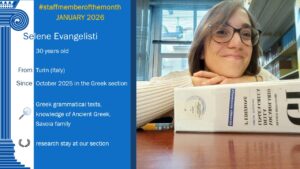
Hi Selene! Can you tell us more about your PhD project? In one sentence, how would you describe it to someone at a dinner party who just asked out of politeness — and then, more seriously, what first drew you to studying Greek grammars from the old collection of the Biblioteca Nazionale Universitaria di Torino, and what was Greek actually doing at the court of the Dukes of Savoy (prestige, politics, humanism, education…)?
Hello, everyone! I like to joke saying that I study burnt sheets of paper, sometimes the size of a stamp, which were once entire manuscripts, containing Greek grammar texts. The goal, of course, is to discover how Turin teachers in the 1500s tortured students to make them learn Greek!
More seriously, I’m interested in Greek grammar texts because of my passion for teaching (before my PhD, I taught Latin and Greek in high schools for three years). And, also, there is an aura of mystery surrounding the arrival and knowledge of Greek in Turin: when Greek manuscripts first arrived, was Ancient Greek already known? Was it studied? If so, how, where and from which texts? During my research, for example, I discovered that from middle 1400s onwards, the study of Ancient Greek was part of the education of the Savoia, the royal family in Turin. During the same period, people who had taught Greek in other Italian or European cities stayed at court for fairly long periods. Now, it is a matter of connecting people and books!
I’m interested in Greek grammar texts because of my passion for teaching. And, also, there is an aura of mystery surrounding the arrival and knowledge of Greek in Turin: when Greek manuscripts first arrived, was Ancient Greek already known? Was it studied? If so, how, where and from which texts?
What would surprise people most about your work?
Most people think that in such a “peripheral” area of Renaissance Italy, as Turin, there is not much to discover about Ancient Greek. When one thinks of the great centres of Greek culture in Italy, Venice, Milan, Rome, Padua and Florence immediately spring to mind…certainly not Turin. The Savoia family in the common sense was more interested in military campaigns than literature. However, the collection of Greek manuscripts at the Biblioteca Nazionale has a truly fascinating history, lost in the Piedmontese fog and in the flames, literally. In 1904, the library burned down and many codices were lost. Before that fire, the library held more than 400 Greek codices, including a surprising number of grammars. So much for the periphery!
Why did you choose Ghent for your exchange period? Was there a person, research tradition, or environment that made it the right place?
I chose UGent for my research stay because I was curious to learn more about the work and results of the MELA project. I also wanted to meet and exchange views in person with the research team, especially considering the project’s strong interest in Greek grammar texts. It seemed like a good idea to take a peek at their methodological approaches, in the hope of returning home with some new ideas and useful insights for my work. And it really was. The work environment is excellent: the team welcomed me with kindness and helpfulness, sharing their time, expertise and enthusiasm.
I chose UGent for my research stay because I was curious to learn more about the work and results of the MELA project. I also wanted to meet and exchange views in person with the research team, especially considering the project’s strong interest in Greek grammar texts.
A final question: When you leave Ghent, what do you think you’ll miss the most – academically or personally?
The weather, obviously! Just kidding… when I’ll go back to Turin at the end of March, I’m definitely going to miss the MELA team and, above all, my colleagues at the office. Over the last few months, they have practically adopted me (and, on many occasions, fed me!), making me feel at home. But that’s not all: also the exchange of ideas and the discussion about different ways of approaching research has been very fruitful. I think I’ll be taking home with me some new methodological ideas, a few cuberdons (of course!) and a lot of gratitude for you all!