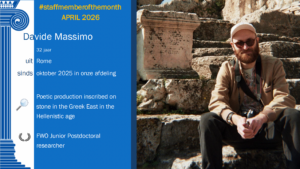
The staff member of this month is Davide Massimo, who joined the Greek section in October 2025! Divna Manolova sat down with him to discuss his research, his almost suspiciously impressive organizational skills, and the baked goods that have already secured his place in departmental history.
Hello, Davide! I am very excited to have the opportunity to ask you a few questions about yourself and your research. To begin with, what are the research questions that brought you to UGent, and what are the main working hypotheses you have been testing in recent months?
My connection to UGent came from my strong interest in epigram, which is a big thing around here. My project seeks to map the production of inscribed epigram from the Hellenistic age (3rd-1st cent. BC), with a specific focus on the Greek East, a region stretching from the Asia Minor and the Eastern Mediterranean to Central Asia, which became “Hellenised” after the conquests of Alexander the Great. I use scare quotes here because “Hellenisation” is a complex and problematic category, based on a colonial model for which the Greeks brought Greek culture to these new places and imposed it on local cultures. Recent scholarship has proposed different models for interpreting these cultural encounters in a more nuanced way, and I believe these can benefit from the study of verse inscriptions too. For example, I have recently finished a long paper on some Greek verse inscriptions from Iran, which (I contend) show much more engagement with local cultures than previously thought. Overall, my aim is to put this material on the map of Hellenistic poetry where it belongs and to understand how it relates to “traditional” Hellenistic poetry, which people have been focusing on much more. It means writing a new chapter in the history of Greek literature, which is very exciting.
I have recently finished a long paper on some Greek verse inscriptions from Iran, which (I contend) show much more engagement with local cultures than previously thought. Overall, my aim is to put this material on the map of Hellenistic poetry where it belongs.
You are working on verse inscriptions. What are the main methodological challenges one encounters when working with poetry—and, more specifically, with Hellenistic poetry?
There are many. Epigraphic poetry shares with the rest of epigraphy some very material issues, for example dealing with damaged and fragmentary stones, and also stones that are hard to locate or missing for various reasons (poor management, transport, looting, war…). There are, however, challenges specific to inscribed poetic material. The first is the difficulty of dating it: for example, in my case, to single out what is Hellenistic. Without explicit dates, we are often bound to make guesses about the chronology based on the shape of the letters on the stone and the stylistic features of the poems, and both these methods are far from foolproof. Another problem is the authorship of these poems. Most of them are anonymous and it’s hard to work out a socio-cultural profile of their authors. The repetition of certain phrases across stones scattered in faraway places has often led to the idea that some handbooks must have been employed, but I believe that further research will increasingly challenge this idea.
Switching gears a bit, you are known as something of a productivity‑tools guru. What are your three favourite types of tools for organising one’s source corpus and workflow?
That’s a difficult question, because what works for me may not work for others, but I’ll try.
1) On the source corpus, it really depends on what material you are working on, but my advice is to look into what is already out there and talk to a lot of people – there might be already something which suits your needs. And if you’re new to digital humanities, there are plenty of resources for beginners (Sunoikisis and the Digital Classicist Wiki are good places to start!).
2) If you don’t do it already, I highly recommend using a citation manager for your bibliographies, such as Zotero (free and open-source!). It’s very easy to use and it also has a browser plugin that instantly captures citations directly from books, articles, or library catalogues…and you can convert your bibliography from e.g. Harvard to Chicago citation stylefairly quickly to suit your needs. Saves a lot of time.
3) I am a very visual person, so I like to visualise the pipeline of my projects in various ways (including good old post-it notes). If you are also like that, I recommend something I’ve learned during a project management training session: Kanban boards, a game changer for me – as well as a source of friendly mockery from some colleagues!
Finally, I also know you to be an enthusiastic baker and the main—and much‑needed—source of all kinds of sweet delights in our office at the Blandijn. What are your favourite (Ghentian and not only) desserts and sweet treats?
It’s quite hard to find a dessert that I *don’t like*, but I certainly have favourites and I do my research. I love chocolate, which IMHO is the best thing about Belgium, and I’ve been enjoying the artistry of the Belgian maîtres chocolatiers in various forms. In colder months, you’ll find me at least once a week indulging in hot chocolate at Mayana, around the corner from the Blandijn, or, as I like to say, “worshipping at the temple”. In terms of local glories, I find waffles fairly basic, but their fantastic smell is always welcome when I get off the train in Brussels Midi (it also helps cover the station’s characteristic stench of urine…). I’m still investigating local treats besides Speculoos. More research is needed.
It’s quite hard to find a dessert that I *don’t like*, but I certainly have favourites and I do my research.
Outside Belgium, my passions lie in fin de siècle Austro-Hungarian confectionery (think Sacher, Esterházy, Dobos…) and with the decadent flavours of Southern Italy (so anything with almonds or lemons). The many years spent on the British Isles also left a mark on my palate: I do love a scone (the Devon way: cream first, then jam!), but also less popular British delights such as Christmas pudding. I’m always on the lookout for new sweet flavours: recent discoveries include Greek πορτοκαλόπιτα (I had a fantastic one in Athens recently) and Marlenka, a Czech honey cake of Armenian origin.