Romancing Rhetoric: Imperial Fiction and Late-Antique Rhetorical Theories and Practices

Whereas overlaps between rhetoric and Latin and Greek fiction from the Imperial era have long been identified and discussed, most of the work done so far has examined how fiction adopts and builds on rhetorical concepts. This conference proposes instead the opposite route and examines to what extent and how Imperial fiction itself, given its rhetorical nature, contributed to shaping rhetorical theory and practice in the 4th to 6th centuries.

In particular, we are interested in seeing how the practices of ancient fiction in Imperial times (for instance, but not limited to, the extant and fragmentary novels, both so-called ‘pagan’ and early Christian fictional(ized) biographies, imaginative travel accounts, paradoxography, collections of letters, etc.) may have influenced the theory, practice and/or teaching of rhetoric in Late Antiquity (treatises, declamations, orations, progymnasmata, letters, panegyrics, ekphrases, etc.). We hope to reach a better understanding of the narrative and fictional qualities of late-antique rhetorical writing, of the late-antique reception of Imperial fiction, and of rhetoricians as readers of fiction. In this conference we explore the presence of fiction in late-antique rhetorical writing and welcome case studies from a range of texts in Greek and Latin, as well as theoretical approaches.


Organizers: Dr Nicolò D’Alconzo and Prof. Koen De Temmerman

Please register via https://event.ugent.be/registration/RomancingRhetoric by 12th September 2025.

Programme

Day 1 – Thursday 25/09/2025 (Vos / Haas, Floor -1)


9.40-10.00    Welcome and opening remarks (Koen De Temmerman, Nicolò D’Alconzo) 


SESSION 1      Education     (Chair: Nicolò D’Alconzo)

10.00-10.45   Fotini Hadjittofi (Lisbon): Paideia versus Eros: Testing the Limits of Novelistic Love in Gazan Rhetoric.

10.45-11.15      Valentina Barrile (Ghent): Rhetoric, Novels and Education: a Three-way Contamination?

11.15-11.45       Coffee Break

11.45-12.30     Ruth Webb (Lille): Declamation and the Unthinkable: Chorikios Decl. 9 and the Death of the Heroine.


13.00-14.30    Lunch Break


SESSION 2     Practices     (Chair: Koen De Temmerman)

14.30-15.15      Laura Miguélez-Cavero (Madrid): Nonnus’ Fictional Habits: On how to Borrow from the Novel (Achilles Tatius) and History (Herodotus).

15.15-16.00      Richard Flower (Exeter): Storied Emperors: Fiction and Latin Panegyric in Late Antiquity.

16.00-16.30     Coffee Break

16.30-17.00      Chiara Militello (Catania): Rhetorical Devices and Imperial Fiction in Damascius’ Philosophical Turn.

17.00-17.45       Gianfranco Agosti (Pisa): Stories People Like. Fictional Strategies and Audiences in Late Antiquity.


19.00                Conference dinner


Day 2 – Friday 26/09/2025 (Vos / Haas, Floor -1)


SESSION 3      Ekphrasis    (Chair: Ruth Webb)

10.00-10.30    Elena Claudi (Warwick): Looking Forward in Ekphrasis: Illusion in the Imagines of Philostratus and the Descriptions of Callistratus.

10.30-11.00     Arianna Canu, Viola Palmieri (Tübingen): Through the Eyes of the Guide: Theory in the Practice of Ekphrasis from Imperial Age to Late Antiquity.

11.00-11.30      Coffee Break

11.30-12.00     Carlos Amado Román (Extremadura): Rhetorizing the Nile: Achilles Tatius and Himerius.

12.00-12.30    Koen de Temmerman (Ghent): A Meadow Imitating a Painting: Procopius of Gaza on Fiction.


12.30-14.00    Lunch Break


SESSION 4      Letters    (Chair: Claire Rachel Jackson) (Verwondering, Floor 2)

14.00-14.45    Lieve Van Hoof (Ghent): From rhetorical microtexts to narrative macrotext: Book 5 of Libanius’ letter collection.

14.45-15.15      Amedeo Raschieri (Milan): Rhetoric and Self-Representation in Late Antiquity: The Interplay Between Ennodius’ Letters and Dictiones.

15.15-15.45       Steven Smith (Boston): Achilles Tatius’ Leukippe & Kleitophon and Theophylact Simocatta’s Letters: Nature, Language, and Gender.

15.45-16.15       Coffee Break

16.15-16.45       Cristiano Minuto (Naples): On the Reception of Heliodorus’ Aethiopica in Aristaenetus’ Letters: Calasiris’ Narrative as a Case Study.

16.45-17:15       Giuseppe Zanetto (Milan): ‘Milesian Aristaenetus’: How to Liven up Rhetorical Prose?


17.15:17.30        Closing Remarks

Paratexts in Premodern Writing Cultures

The Database of Byzantine Book Epigrams project (DBBE) will organize a conference on “Paratexts in Premodern Writing Cultures”, which will take place in Ghent on 24-26 June 2024. 

With this conference we aim to bring together scholars engaged in the exploration of premodern paratexts transmitted in a variety of languages (such as Arabic, Armenian, Greek, Coptic, Hebrew, Latin, Slavonic, Syriac). It is our aim to discuss the nature of paratextuality in medieval manuscripts, to reveal similarities and peculiarities of paratexts across language borders, and to understand the broader cultural and historical ramifications of paratexts. We are interested both in the textual evidence of medieval paratexts and in their material transmission.


For all further information, please visit the conference website: https://www.dbbe2024.ugent.be/.
For any additional questions you may have, please contact the organisers at dbbe@ugent.be.

Conference: Monsters in the classroom – Latin and Greek at primary school

This international conference is dedicated to the teaching of Latin and Ancient Greek at Primary school, with talks and discussions by practitioners from Belgium, France, Germany, Greece, Italy, The Netherlands, the United Kingdom, and the United States. The conference is open to all: we invite teachers and students from all levels of education and other interested parties from any country to join the discussions on organization, pedagogy, and inclusivity.

Conference language: English. Simultaneous translation into French available.

When: 26 January 2022 from 2 to 6pm Central European Time on Zoom

More information and registration: https://www.oudegriekenjongehelden.ugent.be/conference/

OIKOS crash-course in Greek palaeography

! UPDATE ! Due to the current COVID-19 restrictions, the Crash Course has been postponed to 23-24 May 2022.

The Greek department of Ghent University offers a two-day course in Greek palaeography in collaboration with the Research School OIKOS. The course is intended for MA, ResMA and doctoral students in the areas of Classics, Ancient History, Ancient Civilizations and Medieval studies with a good command of Greek. It offers an chronological introduction into Greek palaeography from the Hellenistic period until the end of the Middle Ages and is specifically aimed at acquiring practical skills for research involving literary and documentary papyri and/or manuscripts. We will also provide the unique opportunity to read from original papyri in the papyrus collection of the Ghent University Library and become familiar with the ongoing research projects at Ghent University.

Programme

The course is set up as an intensive two-day seminar. Five lectures by specialists in the field will give a chronological overview of the development of Greek handwriting, each followed by a practice session reading relevant extracts from papyri and manuscripts in smaller groups under the supervision of young researchers (Antonia Apostolakou, Dr. Julián Bértola, Serena Causo, Cristina Cocola, Anne-Sophie Rouckhout, Emmanuel Roumanis and Nina Vanhoutte).

Monday, may 23

10:00 Welcome

10:30-11:30 Papyri of the Ptolemaic and Roman period (Dr. Joanne Stolk)

11:30-13:00 Practice with papyri of the Ptolemaic and Roman period

13:00-14:00 Lunch break

14:00-15:00 Papyri of the Byzantine period (Dr. Yasmine Amory)

15:00-16:30 Practice papyri of the Byzantine period

16:30-17:00 Tour around the papyrus collection of the Ghent University Library

19:00 Dinner


Tuesday, may 24

9:00-10:00 Majuscule and early minuscule bookhands (4th-9th centuries) (Dr. Rachele Ricceri)

10:00-11:30 Practice majuscule and early minuscule bookhands

11:30-12:00 Coffee break

12:00-13:00 The development of minuscule script (10th-12th centuries) (Prof. dr. Floris Bernard)

13:00-14:00 Lunch break

14:00-15:30 Practice minuscule script of the 10th-12th centuries

15:30-16:00 Coffee break

16:00-17:00 Manuscripts and scholars of the Paleologan period (13th-15th centuries) (Prof. dr. Andrea Cuomo)

17:00-18:30 Practice manuscripts of the Paleologan period

Registration

Please register by sending an e-mail with a short motivation, including your background, research interests and why you would like to follow this course, to yasmine.amory@ugent.be. Priority is given to OIKOS doctoral students, beginners and those who did not have the opportunity to follow course(s) on palaeography before. Registration closes when the course is fully booked (20 participants) or by the final deadline of January 15, 2022. Participants receive 2 ECTS for completing the course.

If due to changing circumstances the course cannot take place in Ghent, the lectures will be offered online to the participants on the same dates. Practice sessions will be replaced by reading assignments with feedback by the teachers.

Congres: Enchanted reception: Religion and the supernatural in medieval Troy narratives 

Enchanted reception: Religion and the supernatural in medieval Troy narratives  

Programme

Date: Thursday-Friday, 3-4 June 2021

Please register via this linkhttps://eventmanager.ugent.be/EnchantedReception

Enchanted Reception is a two-day workshop with the aim of exploring the place of enchantment, myth, and religion in both Eastern and Western medieval narratives about Troy, or narratives that are influenced by motifs related or parallel to the narrative of the Trojan war. Together with scholars specialising in the different language traditions of medieval literature, we aim to explore the following questions from a transnational approach:

•    How did contemporary (e.g. literary and socio-cultural) developments influence medieval adaptations of the supernatural and pagan religion in medieval Troy narratives?
•    What role does the Troy motif play in other literary works?
•    How are rationalization and “Christianization” used to deal with the medieval unease evoked by certain aspects of ancient mythology?
•    From a comparative perspective, how can we map such processes transnationally, e.g. in the different language and literature traditions of the medieval world?
•    How do these questions engage with themes such as gender, sexuality, ethnicity and cross-cultural connections?

For the programme, see https://www.novelsaints.ugent.be/event/enchanted-reception.

Biblical Poetry: The Legacy of the Psalms in Late Antiquity and Byzantium​

The conference brings together scholars working on the reception of the Psalms in later Greek poetry and exegetical literature. The Psalms were a fundamental corpus of biblical poetry, and as such were continuously referred to in Christian literature (in their Greek Septuagint translation). They played a key role in the daily life and in the development of religious sensitivity of writers from Late Antiquity and Byzantium. The production of literature related to the Psalter, notably exegetical, was impressively widespread. The Psalms influenced other genres of religious literature as well, and their poetical nature remained an important feature that later authors were well aware of. Topics that will be addressed during the conference are diverse both chronologically and thematically.

For more information: https://www.psalms2020.ugent.be

! CANCELLED ! Growing Corpora. Byzantine Book Epigrams and Online Text Collections


Since 2010, the Database of Byzantine Book Epigrams team have been growing an online corpus of metrical paratexts, several of which were previously unpublished or unknown altogether, and made them freely available to the scholarly community.

A new version of our database (https://www.dbbe.ugent.be) was launched in June 2019. Exactly one year later, we are organising a two-and-a-half-day conference. Together with anyone interested in this particular genre of Byzantine poetry, we want to celebrate and reflect on what we have achieved so far and look ahead at what is – hopefully! – yet to come. Moreover, we want to stimulate communication and collaboration with other projects that are growing online corpora of texts.

For any further information, please visit our conference website (https://www.dbbe2020.ugent.be).

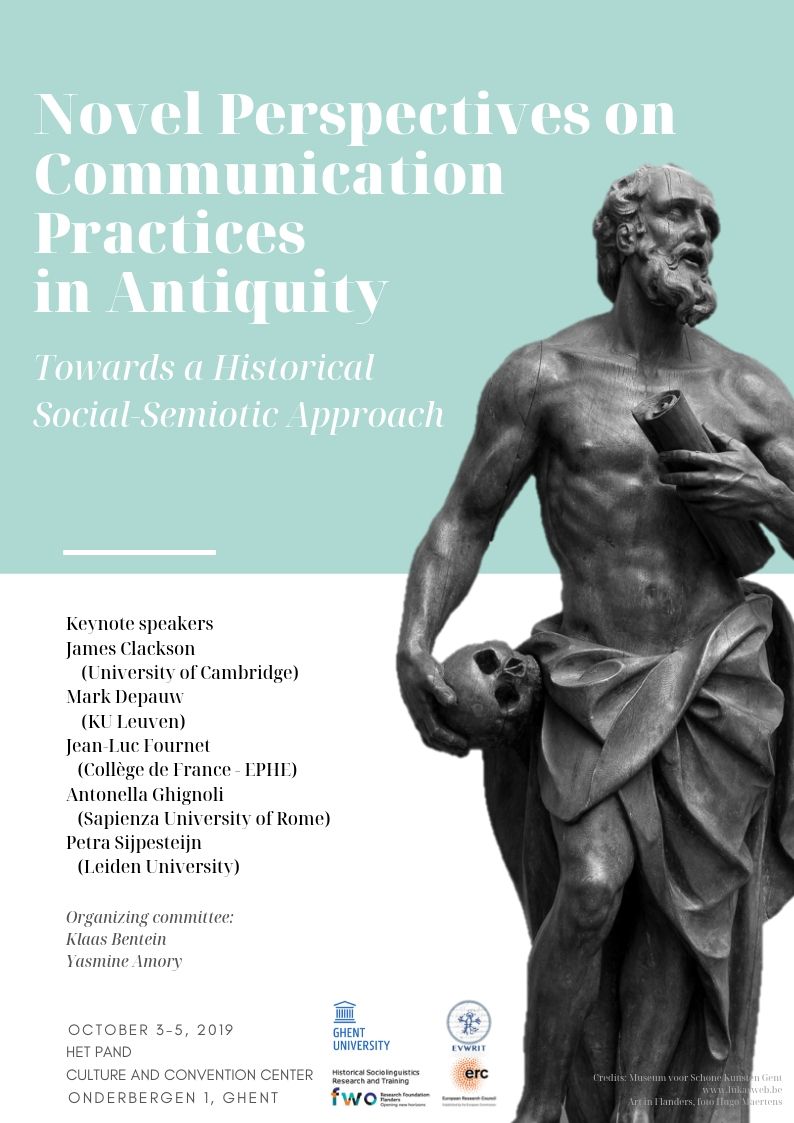
Novel Perspectives on Communication Practices in Antiquity

Outline

Sociolinguists initially showed little concern for texts from the past, William Labov, the founding father of sociolinguistics, famously characterizing historical linguistics as ‘the art of making the best use of bad data’ (Labov 1994:11). Nowadays, historical socio-linguistics, too, has come to maturity as a sub¬discipline (see e.g. Conde-Silvestre & Hernandez-Campoy 2012), with researchers trying to identify dialectal relationships between language and society. Contemporary sociolinguistic insights form the basis for these descriptions, but given the complexity of the subject, a radically interdisciplinary approach has been in the making, combining insights from corpus linguistics, historical linguistics, philology, and semiotics.

One question which has received relatively little attention so far is to what extent other ‘meaning-making’ dimensions could and should be involved in the investigation. In recent years, scholars such as Bob Hodge, Gunther Kress and Theo van Leeuwen have explicitly drawn attention to the ‘multi-modal’ nature of communication, arguing that people also use – next to language – visual, gestural, musical, choreographic, and actional resources to make meaning. Remarkably, however, the new discipline of Social Semiotics is currently restricted to the analysis of modern-day texts. Parallel to what we have seen with the development of sociolinguistics, there is little interest in texts from the past: one recent textbook, for example, is explicitly entitled ‘Multimodality. A social semiotic approach to contemporary communication’ (Kress 2010; our emphasis).

The main aim of this conference, which forms the opening event of the ERC-project ‘Everyday writing in Graeco-Roman and Late Antique Egypt. A socio-semiotic study of communicative variation’ (2018-2023; www.evwrit.ugent.be), is to explore to what extent it is possible and desirable to found a discipline such as historical social-semiotics, parallel to historical socio-linguistics. Such a novel, interdisciplinary approach is particularly relevant for ‘everyday’ documentary texts: since these texts represent autographs, their external characteristics can also be brought into the interpretation. Jean-Luc Fournet (2007), for example, has recently argued for a ‘paléographie signifiante’, noting that ‘l’analyse matérielle d’un document peut être porteuse de sens’ (2007:353), not only when it comes to text type, but also with regard to the socio-cultural context of writing, and the provenance of the document. Other external characteristics to be considered as expressions of social meaning (functioning as ‘semiotic resources’) are – but are not limited to – writing material, document format, and language choice. Their analysis reveals information concerning hierarchy, status and social relations.

The main focus of the conference will be documentary texts from the Mediterranean region, roughly spanning the period from the first millennium BCE to the first millennium CE. Next to the study of specific (linguistic, palaeographic, material, etc.) features, we consider the following questions to be of particular relevance:

– Which ‘semiotic resources’ should be taken into account when studying Ancient texts?
– How are these different semiotic resources interrelated?
– Can certain semiotic resources express types of meaning which other resources cannot?
– Which types of social meaning are expressed through communicative variation?
– How are these different types of social meaning related to each other?
– Is it possible to identify larger patterns of co-occurrence, extending linguistic concepts such as ‘register’ and ‘genre’ to other domains?
– Which diachronic changes can be observed?
– How do ‘everyday’ texts from Egypt compare to texts found elsewhere?
– Which digital tools are required for the discipline of historical social-semiotics?
– Which theoretical concepts from social semiotics can be further developed?
– What role do scribes play for the social-semiotic analysis of ancient texts?
– What kind of standards were there for ‘everyday’ communication practices?


References
Conde-Silvestre, J.C. & J.M. Hernandez-Campoy 2012. The handbook of historical sociolinguistics. Malden.
Fournet, J.-L. 2007. “Disposition et réalisation graphique des lettres et des pétitions protobyzantines: Pour une paléographie ‘signifiante’ des papyrus
documentaires”. In: J. Frösén (ed.), Proceedings of the 24th international congress of papyrology, 353-367. Helsinki.
Kress, G. 2010. Multimodality: A social semiotic approach to contemporary communication. New York, NY.
Labov, W. 1994-2010. Principles of linguistic change. Vol. 1: Internal factors. Vol. 2: Social factors. Vol. 3: Cognitive and cultural factors. Oxford.


Organizing committee

Klaas Bentein
Yasmine Amory

Scientific committee
Antonia Apostolakou – Eleonora Cattafi – Serena Causo – Giovanbattista Galdi – Mark Janse – Geert de Mol – Emmanuel Roumanis – Joanne Stolk

www.evwrit.ugent.be

www.novelperspectives.ugent.be

Walking the Wire. Latin and Greek Late Antique Poetry in Dialogue

Organization: Berenice Verhelst and Tine Scheijnen

The Walking the Wire project springs from the general observation that there is very little interaction between scholars working on Late Antique Greek and Late Antique Latin poetry. Although similar problems and questions arise in research on both poetical traditions, a real dialogue between these two scholarly fields is still conspicuously missing. It is our conviction that a stronger dialogue is needed between the two fields to come to a better understanding, not only of the shared developments, but also of the subtle differences between the two traditions, which are now often overlooked or simplified because of the lack of any comparative studies.

The bilingual focus of our project and the book which will be its result is chosen explicitly to open up the dialogue between the two fields and explore the possibilities this creates to come to a better understanding of Late Antique poetry. It aims to shed new light on literary developments that can or have been regarded as typical for Late Antiquity and on the poetic and aesthetic ideals that affect individual poems from this period. Only by analyzing this poetry from a bilingual perspective is it possible to correct common misunderstandings about the extent to which certain literary phenomena are typically “Late Antique”, “Latin” or “Greek”.

8 September 2016

  • 09.30     Arrival & Coffee
  • 10.00     Berenice Verhelst and Tine Scheijnen (Ghent): Introduction

MORNING SESSION. PART ONE: POETRY IN TRANSFORMATION

Chaired by Kristoffel Demoen (Ghent)

  • 10.30:    Philip Hardie (Cambridge) – Respondent: Sophie Schoess
    Metamorphosis and Mutability in Late Antique Epic
  • 11.15:    Helen Kaufmann (Oxford) – Respondent: Silvio Bär
    The Implosion of Poetic Genre in Late Antiquity

LUNCH (12.00-13.30)

AFTERNOON SESSION. PART TWO: POETRY AND THE WORLD OF LATE ANTIQUITY

Chaired by Jacqueline Klooster (Groningen)

  • 13.30:    Aaron Pelttari (Edinburgh) – Respondent: Laura Miguélez Cavero
    Speaking from the Margins: Late Antique Paratexts from around the Mediterranean
  • 14.15:    Sophie Schoess (Oxford) – Respondent: Cosetta Cadau
    Objects of the Lusting Gaze: Viewing Women as Works of Art in Late Antique Poetry
  • 15:00:   Gianfranco Agosti (Roma Sapienza) – Respondent: Klazina Staat (Ghent)
    Centre and periphery in “everyday poetry” of Late Antiquity

COFFEE BREAK (15.440-16.30)

Chaired by Koen De Temmerman (Gent)

  • 16.30:    Calum Maciver (Edinburgh) – Respondent: Katerina Carvounis
    The Vertical and Horizontal Axes: the Limits of Alexandrian Poetics in a Rhetorical Context?
  • 17.15:    Cosetta Cadau (Dublin) – Respondent: Philip Hardie
    Describing Female Beauty in Late Antiquity. Aphrodite in Claudian, Colluthus and Nonnus.


RECEPTION (18.00-19.00)

CONFERENCE DINNER (19.30 – Restaurant: Vier Tafels)

9 September 2016

  • 30:    Coffee

MORNING SESSION. PART THREE: SHAPING AND RESHAPING THE PAST

Chaired by Mary Whitby (Oxford)

  • 10.00:    Marcelina Gilka (Exeter) – Respondent: Helen Kaufmann
    “Antehomeric” Traditions and Innovations. Dracontius’ Latin and Colluthus’ Greek Abduction of Helen
  • 10.45:    Katerina Carvounis & Sophia Papaioannou (Athens) – Respondent: Marcelina Gilka
    Alternative Typhonomachies in Ovid and Nonnus. Revisiting the Burning Issue of Latin Influence on Greek Poetry in Late Antiquity
  • 11.30:    Silvio Bär (Oslo) – Respondent: Sophia Papaioannou
    The Past, a Foreign Country? The Recollection and Construction of Literary Canons by Greek and Roman Epigrammatists in the Fourth Century A.D.

LUNCH (12.15-14.00)

AFTERNOON SESSION. PART FOUR: REINVENTING EPIC

Chaired by Marco Formisano (Ghent)

  • 14.00:    Brian Sowers (Brooklyn) – Respondent: Aaron Pelttari
    Common Texts, (Un)Common Aesthetics: the Greek and Latin Cento in Dialogue
  • 14.45:    Laura Miguélez Cavero (Oxford) – Respondent: Emma Greensmith
    Internal Audiences in the New Testament Epics of Nonnus and Juvencus

COFFEE BREAK (15.30-16.00)

Chaired by Wim Verbaal (Ghent)

  • 16.00:    Emma Greensmith (Cambridge) – Respondent: Brian Sowers
    Saying the Other. Allegory and Identity in Quintus of Smyrna and Late Antique Concepts of Personification
  • 16.45:    Berenice Verhelst (Ghent) – Respondent: Calum Maciver
    A “Revival” of the “Epyllion” as a “Genre”? Genre Awareness in Short Epic Narrative from Late Antiquity
  • 17.30: Concluding Round Table – chaired by Tine Scheijnen and Berenice Verhelst